

Location
CoLab, COM 100
Start Date
1-5-2025 9:45 AM
Document Type
Poster
Description
Monitoring flying squirrels aims to assess and study the population of the Southern Flying Squirrel. With increasing urban growth and decreasing natural land in Johnson County and surrounding areas it is somewhat unknown how this squirrel population is affected. In this study, monitoring will take place in several locations, Cedar Niles, Shawnee Mission Park, Antioch Park, Quivira Park, and Thomas S Stoll Park. In each area monitoring devices will be set up, such as acoustic monitoring, trail cameras nest boxes. The research will revolve around how certain hardwoods such as beech, hickory, maple, oak, and poplar, all of which are preferred by the Southern Flying Squirrel, affect activity levels and location of this mammal. Data will be collected by using trail cameras, acoustic monitoring devices, and nest boxes. It is hypothesized that there will be a higher number of flying squirrel incidents and sightings in research sights where beech, hickory, maple, oak, and poplar trees are more densely located rather than in locations where these tree species do not exist at all or are sparse.
Image
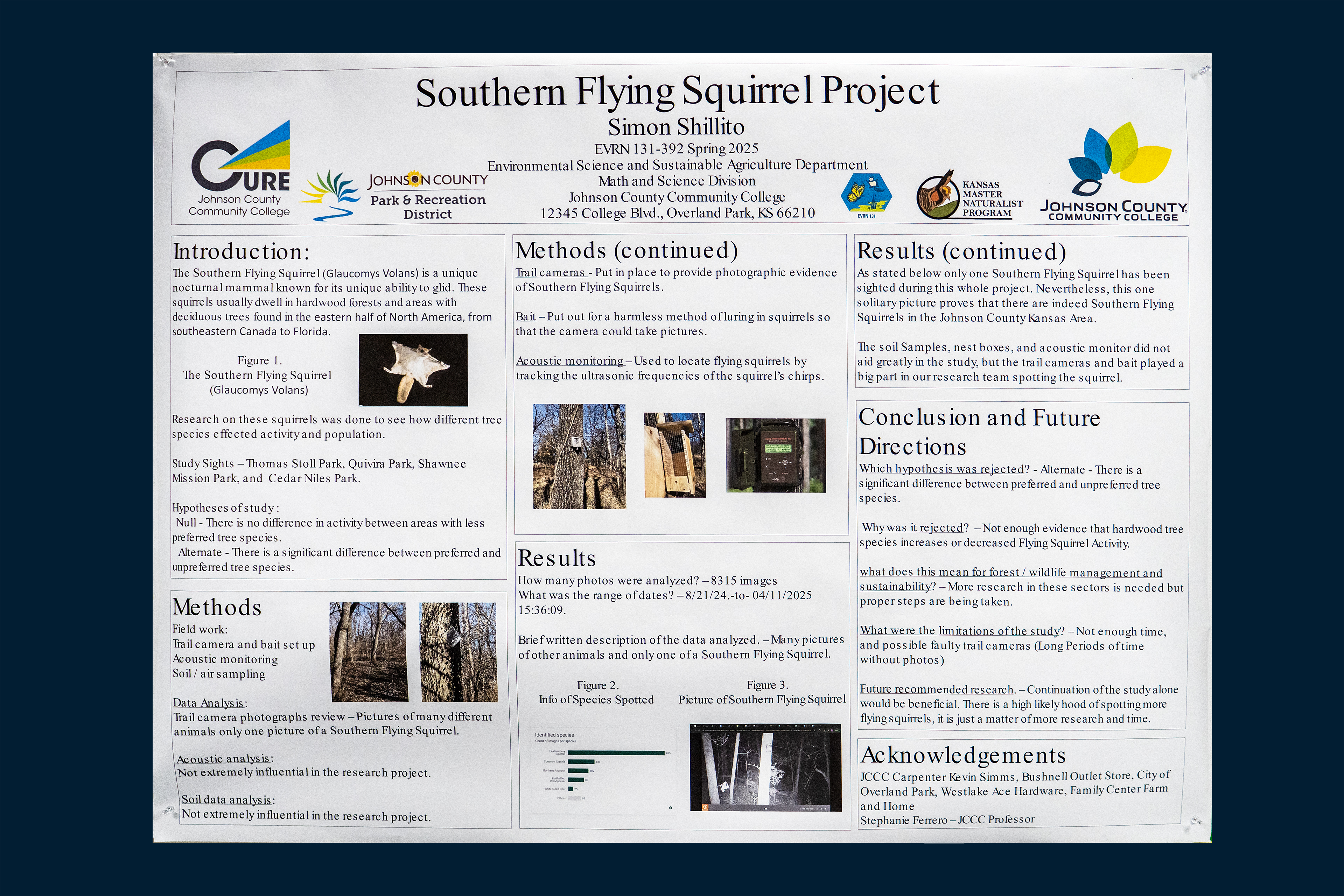
Southern Flying Squirrel Project
CoLab, COM 100
Monitoring flying squirrels aims to assess and study the population of the Southern Flying Squirrel. With increasing urban growth and decreasing natural land in Johnson County and surrounding areas it is somewhat unknown how this squirrel population is affected. In this study, monitoring will take place in several locations, Cedar Niles, Shawnee Mission Park, Antioch Park, Quivira Park, and Thomas S Stoll Park. In each area monitoring devices will be set up, such as acoustic monitoring, trail cameras nest boxes. The research will revolve around how certain hardwoods such as beech, hickory, maple, oak, and poplar, all of which are preferred by the Southern Flying Squirrel, affect activity levels and location of this mammal. Data will be collected by using trail cameras, acoustic monitoring devices, and nest boxes. It is hypothesized that there will be a higher number of flying squirrel incidents and sightings in research sights where beech, hickory, maple, oak, and poplar trees are more densely located rather than in locations where these tree species do not exist at all or are sparse.
Comments
The faculty mentor for this project was Stephanie Ferrero, Environmental Science.