

Location
CoLab, COM 100
Start Date
1-5-2025 9:45 AM
Document Type
Poster
Description
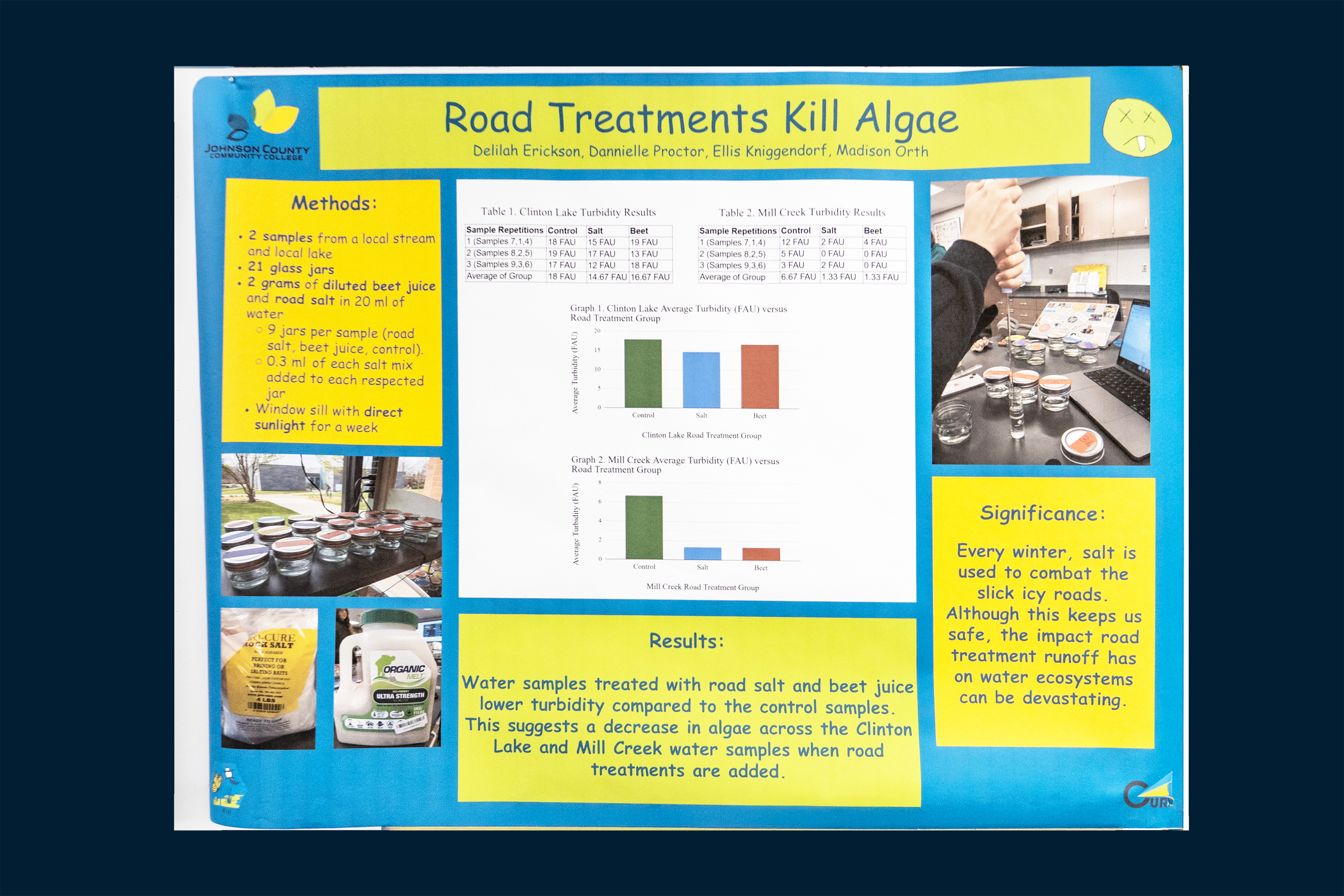
Our experiment is designed to test if different road treatments (road salt and beet juice based) have any different impact on algae growth in water samples. The results could help determine if current road treatment options are better to avoid harmful algal blooms (HABs) developing in our local water bodies since HABs present an increasing threat to local species and, if left unchecked, a public health concern. We are measuring algae presence by a turbidity difference between the samples and a similar tap water sample. We are using two water samples collected from two local sources (from Clinton Lake and Mill Creek) each divided into 9 small glass jars divided three ways: A control with no addition, a group with an added (diluted) sample of road salt, and a group with an added (diluted) sample of beet juice derived road treatment. There are also three tap water samples divided the same way. This will be done to set a baseline to zero our spectrophotometer we are using to measure the turbidity. These samples are all left in the same location (the raised shelf by the Environmental Science Lab exterior facing window) for the same duration (two weeks). The turbidity of each sample will be measured using the respective tap water sample of their group (control, road salt, and beet juice) as the baseline.
Image
Road Treatments
CoLab, COM 100
Our experiment is designed to test if different road treatments (road salt and beet juice based) have any different impact on algae growth in water samples. The results could help determine if current road treatment options are better to avoid harmful algal blooms (HABs) developing in our local water bodies since HABs present an increasing threat to local species and, if left unchecked, a public health concern. We are measuring algae presence by a turbidity difference between the samples and a similar tap water sample. We are using two water samples collected from two local sources (from Clinton Lake and Mill Creek) each divided into 9 small glass jars divided three ways: A control with no addition, a group with an added (diluted) sample of road salt, and a group with an added (diluted) sample of beet juice derived road treatment. There are also three tap water samples divided the same way. This will be done to set a baseline to zero our spectrophotometer we are using to measure the turbidity. These samples are all left in the same location (the raised shelf by the Environmental Science Lab exterior facing window) for the same duration (two weeks). The turbidity of each sample will be measured using the respective tap water sample of their group (control, road salt, and beet juice) as the baseline.
Comments
The faculty mentor for this project was Rebecca Layne, Environmental Science.