

Location
CoLab, COM 100
Start Date
1-5-2025 9:45 AM
Document Type
Poster
Description
We present the photometric data of the star SS Aurigue. This star is part of the Auriga constellation and is a cataclysmic variable discovered by E. Silbernagel. This means that SS Aur and another star both orbit around a common center of mass. From Earth, the two stars are impossible to visually tell apart so they appear to be one star. This star has a right ascension of 06h, 13m, 22s and a declination of +47h, 44m, 25s. It has a temperature in the range of 10,000-30,000 Kelvin with its magnitude of 10.3-15.8 M. SS Aurigue is also an astounding 847.38 Light years from Earth. It has an orbital period of 55.5 days which means that it takes 55.5 days to return to the same position in its orbit. Based on observations that measure how much X-Ray light that the star emits over a time period, it was found that SS Aurigue has oscillations that take place for about 1 hour each night. These oscillations vary by about 30 percent.
Image
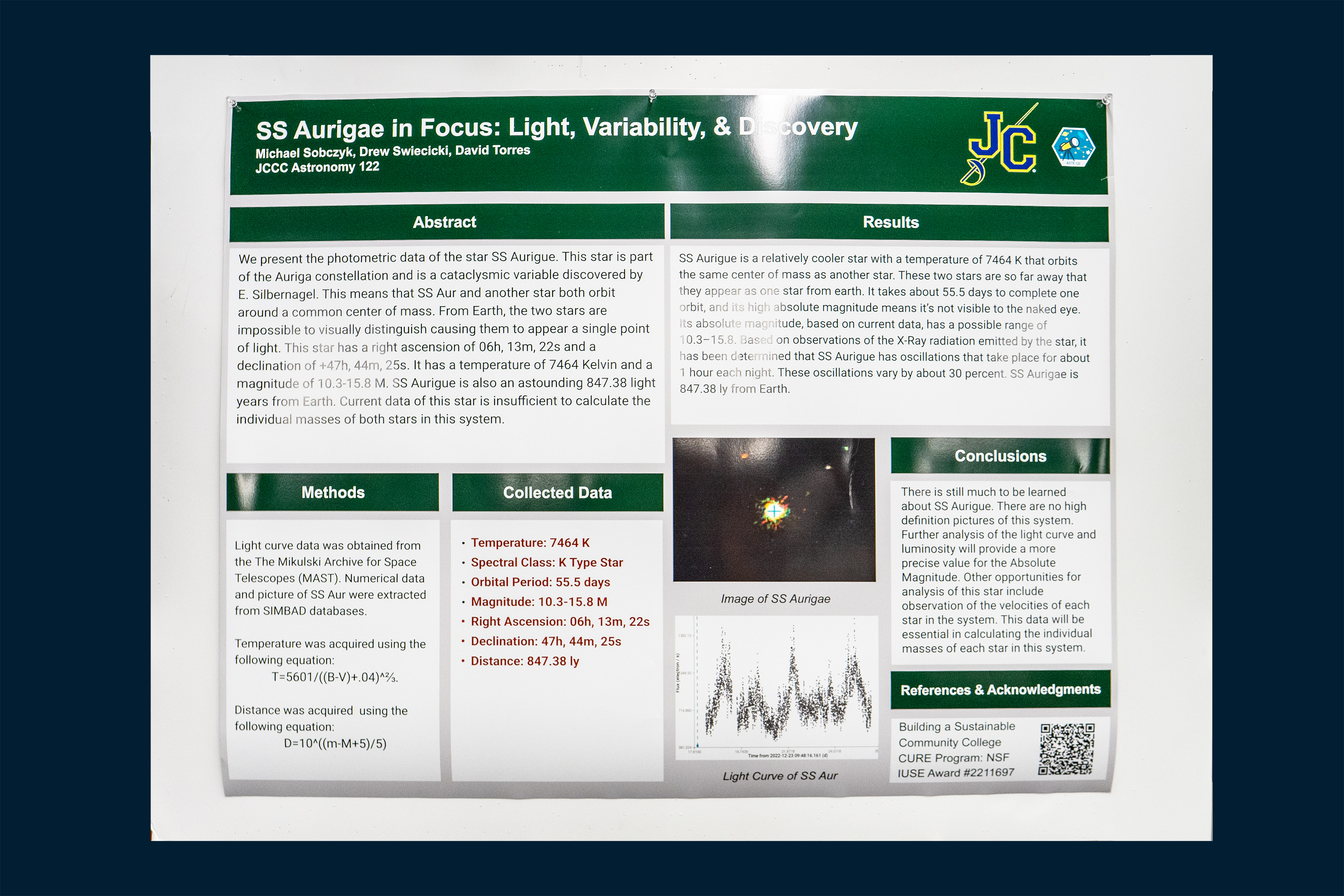
Photometric Analysis of SS Aurigue
CoLab, COM 100
We present the photometric data of the star SS Aurigue. This star is part of the Auriga constellation and is a cataclysmic variable discovered by E. Silbernagel. This means that SS Aur and another star both orbit around a common center of mass. From Earth, the two stars are impossible to visually tell apart so they appear to be one star. This star has a right ascension of 06h, 13m, 22s and a declination of +47h, 44m, 25s. It has a temperature in the range of 10,000-30,000 Kelvin with its magnitude of 10.3-15.8 M. SS Aurigue is also an astounding 847.38 Light years from Earth. It has an orbital period of 55.5 days which means that it takes 55.5 days to return to the same position in its orbit. Based on observations that measure how much X-Ray light that the star emits over a time period, it was found that SS Aurigue has oscillations that take place for about 1 hour each night. These oscillations vary by about 30 percent.
Comments
The faculty mentor for this project was Doug Patterson, Astronomy.