

Location
CoLab, COM 100
Start Date
1-5-2025 9:45 AM
Document Type
Poster
Description
We present a detailed description and analysis about the star system CY Ursa Major, as well as accounting for its unusual and unique behavior throughout years of observation from other sources. Based on information we found from SINBAD, AAVSO, and other observational programs, CY UMa’s is a G-class star with a surface temperature in the range of 5,000 K-6,000 K located at (0 56 56.9964835104 +49 41 18.201049512). Its light curves appear to eclipse and could be a result of its binary nature or an outburst change in its luminosity. We have also found its orbital period of 0.06957 +- 0.00004 days, and we have analyzed the “superoutbursts” which may be affecting it. A major part of this project is its challenge of finding new information that is either not easily accessible or that has not been calculated or recorded like its mass, rotation, luminosity,and other statistics. We will continue to further our research and develop our understanding of our star system and gather as much information for our poster and make our contribution to observational, stellar astronomy.
Image
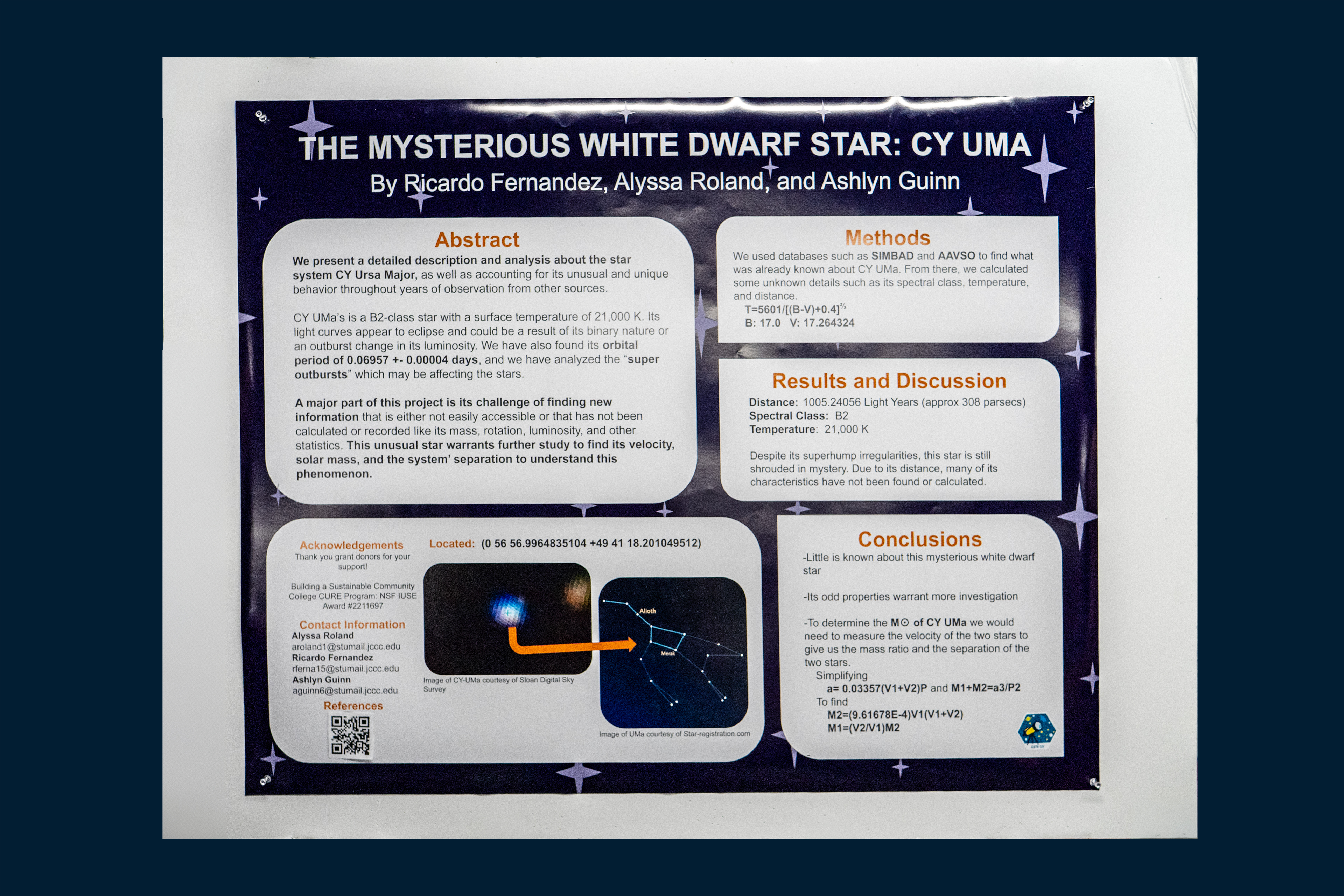
Cataclysmic Variable: CY Ursa Major
CoLab, COM 100
We present a detailed description and analysis about the star system CY Ursa Major, as well as accounting for its unusual and unique behavior throughout years of observation from other sources. Based on information we found from SINBAD, AAVSO, and other observational programs, CY UMa’s is a G-class star with a surface temperature in the range of 5,000 K-6,000 K located at (0 56 56.9964835104 +49 41 18.201049512). Its light curves appear to eclipse and could be a result of its binary nature or an outburst change in its luminosity. We have also found its orbital period of 0.06957 +- 0.00004 days, and we have analyzed the “superoutbursts” which may be affecting it. A major part of this project is its challenge of finding new information that is either not easily accessible or that has not been calculated or recorded like its mass, rotation, luminosity,and other statistics. We will continue to further our research and develop our understanding of our star system and gather as much information for our poster and make our contribution to observational, stellar astronomy.
Comments
The faculty mentor for this project was Doug Patterson, Astronomy.