

Location
CoLab, COM 100
Start Date
1-5-2025 8:30 AM
Document Type
Poster
Description
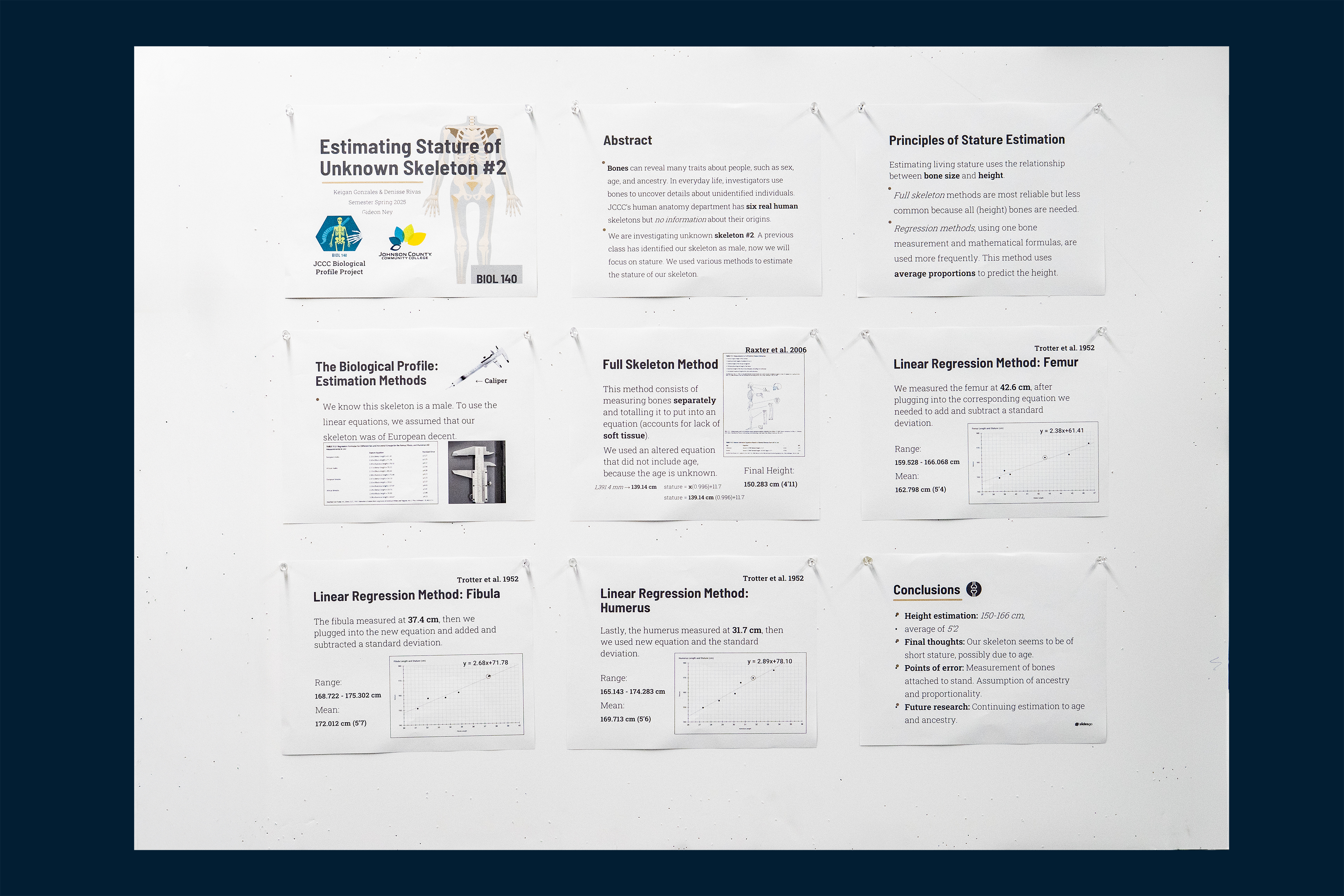
Bones can reveal many traits about people, such as sex, age, and ancestry. In everyday life, investigators use bones to uncover details about unidentified individuals. JCCC’s human anatomy department has six real human skeletons but no information about their origins. We are investigating unknown skeleton #2. A previous class has identified our skeleton as male, now we will focus on stature. We used various methods to estimate the stature of our skeleton. We have used the “Full Skeleton” and the “Linear Regression” methods. With the Full Skeleton method, we measured all the bones that affect a person’s height. The bones we used were the cranium, C2 to L5 vertebrae, the first sacral segment, femur, tibia, talus, and calcaneus. After summing the bones we put our data into a stature formula that accounts for soft tissue. Our results were 150.283cm or about 4’11. Next in the Linear Regression method, we measured the length of the femur, fibula, and, humerus, separately. We do not yet know the ancestry so we assumed they had european ancestry and used the respective linear regression equation. Then we accounted for error by adding and subtracting the standard error. After applying the data to the equation our range was 159.528-166.068cm or an average of about 5’4. This method estimated a few more inches for our skeleton compared to the Full Skeleton method. Any errors could be accounted for in measurements. Future groups can continue to research by finding the ancestry and age of skeleton #2.
Image
Estimating Stature from Unknown Human Skeleton #2
CoLab, COM 100
Bones can reveal many traits about people, such as sex, age, and ancestry. In everyday life, investigators use bones to uncover details about unidentified individuals. JCCC’s human anatomy department has six real human skeletons but no information about their origins. We are investigating unknown skeleton #2. A previous class has identified our skeleton as male, now we will focus on stature. We used various methods to estimate the stature of our skeleton. We have used the “Full Skeleton” and the “Linear Regression” methods. With the Full Skeleton method, we measured all the bones that affect a person’s height. The bones we used were the cranium, C2 to L5 vertebrae, the first sacral segment, femur, tibia, talus, and calcaneus. After summing the bones we put our data into a stature formula that accounts for soft tissue. Our results were 150.283cm or about 4’11. Next in the Linear Regression method, we measured the length of the femur, fibula, and, humerus, separately. We do not yet know the ancestry so we assumed they had european ancestry and used the respective linear regression equation. Then we accounted for error by adding and subtracting the standard error. After applying the data to the equation our range was 159.528-166.068cm or an average of about 5’4. This method estimated a few more inches for our skeleton compared to the Full Skeleton method. Any errors could be accounted for in measurements. Future groups can continue to research by finding the ancestry and age of skeleton #2.
Comments
The faculty mentor for this project was Gideon Ney, Biology.