

Location
CoLab, COM 100
Start Date
1-5-2025 1:30 PM
Document Type
Poster
Description
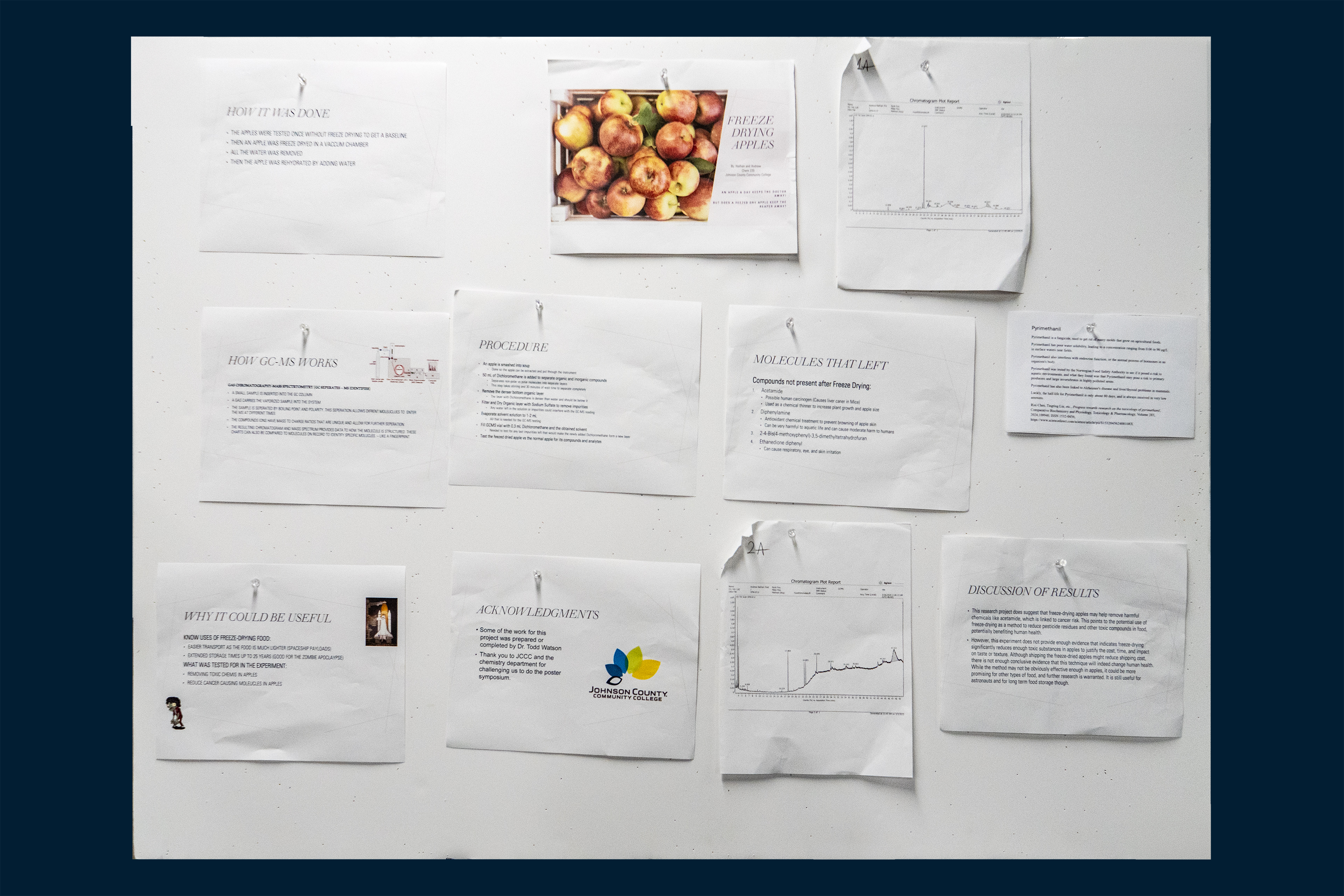
In this experiment Fuji apples bought from the supermarket were tested before and after freeze drying to record different molecules present. Many differences were found before and after, including the taste. Found in the experiment was the absence of acetanilide after freeze drying the apples by comparing the Gas Chromatography Mass Spectrometry (GC-MS) chromatograms before and after freeze drying. Acetanilide is found to be a possible carcinogen and cause of liver and kidney cancer. Freeze-drying apples is already a solution used for reducing payload costs in space missions. By removing moisture content, freeze-drying significantly reduces the weight and volume of food, making transportation to space more efficient. Plus, it is a whole lot cheaper. So, in addition to making food lighter for transportation, the process of freeze drying can help remove harmful chemical compounds such as acetanilide. This purification aspect may lead to healthier food options for astronauts, ensuring long term health in space. Although it is interesting that food for astronauts may be healthier, it is more interesting to know that freeze-drying technology has the potential to benefit human health on Earth. It provides lightweight, nutrient-dense, and safer food alternatives. Particularly in low-income areas with limited access to fresh produce, and with little money to afford food that could be cheaper to transport at reduced weights. All harmful chemicals and pesticides may be removed by freeze drying. Improving food preservation and safety, freeze-drying could play a vital role in both space exploration, earth food safety, and global food security.
Image
The Positives of Freeze-Drying Apples
CoLab, COM 100
In this experiment Fuji apples bought from the supermarket were tested before and after freeze drying to record different molecules present. Many differences were found before and after, including the taste. Found in the experiment was the absence of acetanilide after freeze drying the apples by comparing the Gas Chromatography Mass Spectrometry (GC-MS) chromatograms before and after freeze drying. Acetanilide is found to be a possible carcinogen and cause of liver and kidney cancer. Freeze-drying apples is already a solution used for reducing payload costs in space missions. By removing moisture content, freeze-drying significantly reduces the weight and volume of food, making transportation to space more efficient. Plus, it is a whole lot cheaper. So, in addition to making food lighter for transportation, the process of freeze drying can help remove harmful chemical compounds such as acetanilide. This purification aspect may lead to healthier food options for astronauts, ensuring long term health in space. Although it is interesting that food for astronauts may be healthier, it is more interesting to know that freeze-drying technology has the potential to benefit human health on Earth. It provides lightweight, nutrient-dense, and safer food alternatives. Particularly in low-income areas with limited access to fresh produce, and with little money to afford food that could be cheaper to transport at reduced weights. All harmful chemicals and pesticides may be removed by freeze drying. Improving food preservation and safety, freeze-drying could play a vital role in both space exploration, earth food safety, and global food security.
Comments
The faculty mentor for this project was Todd Watson, Chemistry.