

Location
CoLab, COM 100
Start Date
1-5-2025 8:30 AM
Document Type
Poster
Description
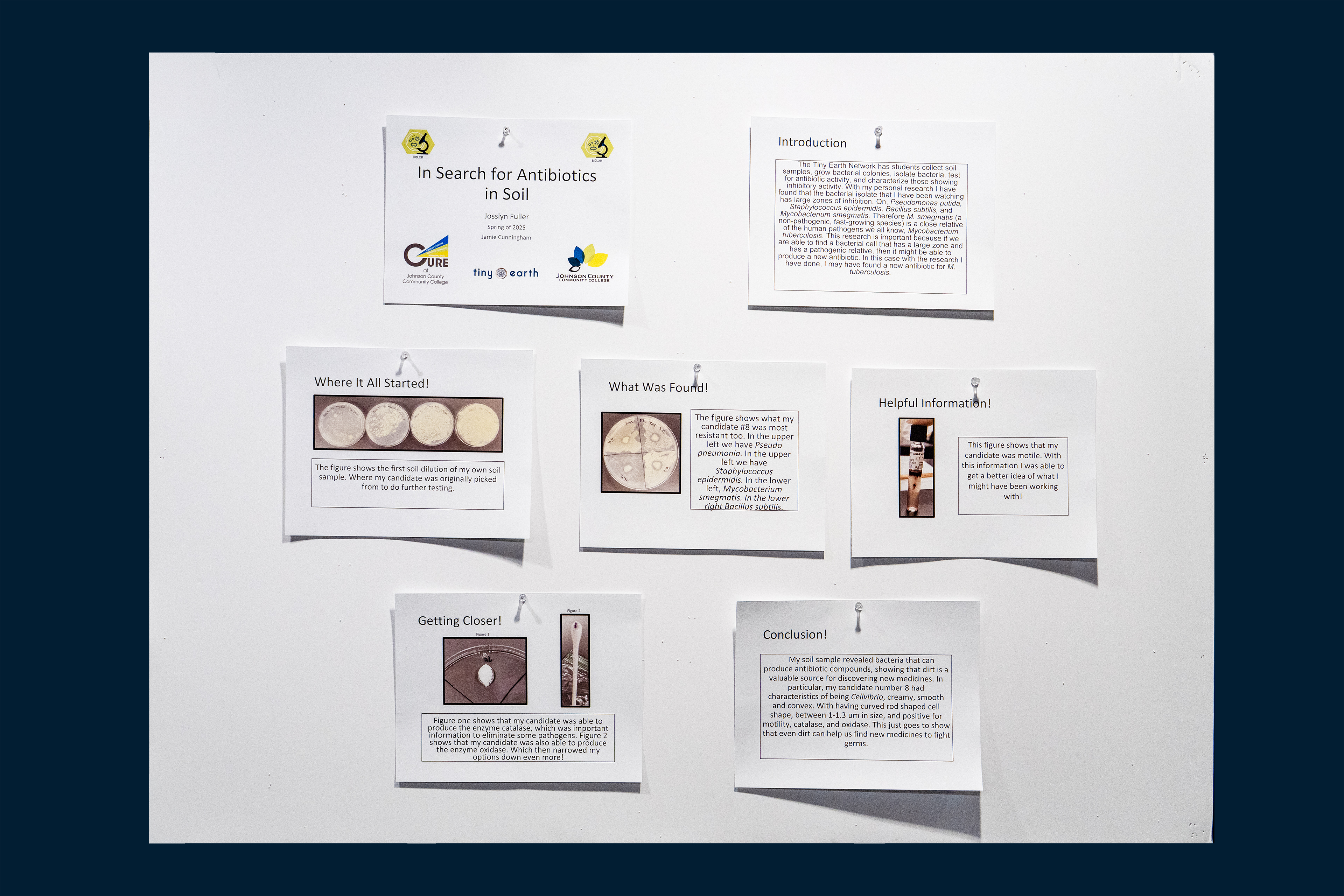
The Tiny Earth Network has students collect soil samples, grow bacterial colonies, isolate bacteria, test for antibiotic activity, and characterize those showing inhibitory activity. With my personal research I have found that the bacterial isolate that I have been watching has large zones of inhibition. on, Pseudomonas putida, Staphylococcus epidermidis, Bacillus subtilis, and Mycobacterium smegmatis. Therefore M. smegmatis (a non-pathogenic, fast-growing species) is a close relative of the human pathogens we all know, Mycobacterium tuberculosis. This research is important because if we are able to find a bacterial cell that has a large zone and has a pathogenic relative, then it might be able to produce a new antibiotic. In this case with the research I have done, I may have found a new antibiotic for M. tuberculosis.
Image
In Search for Antibiotics in Soil
CoLab, COM 100
The Tiny Earth Network has students collect soil samples, grow bacterial colonies, isolate bacteria, test for antibiotic activity, and characterize those showing inhibitory activity. With my personal research I have found that the bacterial isolate that I have been watching has large zones of inhibition. on, Pseudomonas putida, Staphylococcus epidermidis, Bacillus subtilis, and Mycobacterium smegmatis. Therefore M. smegmatis (a non-pathogenic, fast-growing species) is a close relative of the human pathogens we all know, Mycobacterium tuberculosis. This research is important because if we are able to find a bacterial cell that has a large zone and has a pathogenic relative, then it might be able to produce a new antibiotic. In this case with the research I have done, I may have found a new antibiotic for M. tuberculosis.
Comments
The faculty mentor for this project was Jamie Cunningham, Biology.