

Location
CoLab, COM 100
Start Date
1-5-2025 8:30 AM
Document Type
Poster
Description
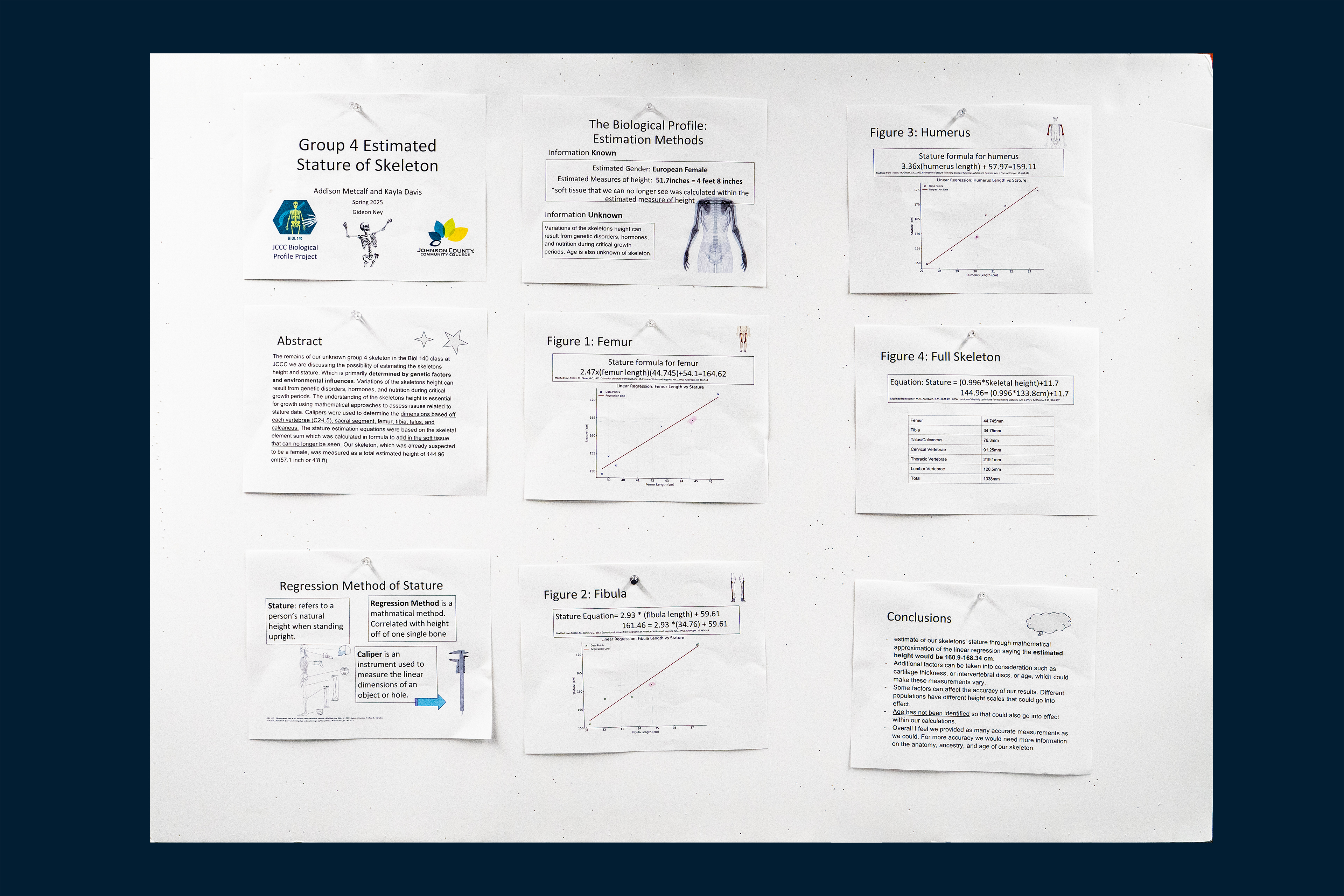
The remains of our unknown group 4 skeleton in the Biol 144 class at JCCC we are discussing the possibility of estimating the skeletons height and stature. Which is primarily determined by genetic factors and environmental influences. Variations of the skeletons height can result from genetic disorders, hormones, and nutrition during critical growth periods. The understanding of the skeletons height is essential for growth using mathematical approaches to assess issues related to stature data. Calipers were used to determine the dimensions based off each vertebrae (C2-L5), sacral segment, femur, tibia, talus, and calcaneus. The stature estimation equations were based on the skeletal element sum which was calculated in formula to add in the soft tissue that can no longer be seen. Our skeleton, which was already suspected to be a female, was measured as a total estimated height of 144.96 cm(57.1 inch or 4’8 ft). This result provides a reasonable estimate of our skeletons' stature through mathematical approximation of the linear regression saying the estimated height would be 160.9-168.34 cm. Additional factors can be taken into consideration such as cartilage thickness, or intervertebral discs, or age, which could make these measurements vary. The results of the skeletal height measurements of the vertebrae and lower limbs provide insight into the stature of our skeleton. Some factors can affect the accuracy of our results. Different populations have different height scales that could go into effect. Age has not been identified so that could also go into effect within our calculations. Overall I feel we provided as many accurate measurements as we could. For more accuracy we would need more information on the anatomy, ancestry, and age of our skeleton.
Image
Group 4 Estimated Skeleton Stature
CoLab, COM 100
The remains of our unknown group 4 skeleton in the Biol 144 class at JCCC we are discussing the possibility of estimating the skeletons height and stature. Which is primarily determined by genetic factors and environmental influences. Variations of the skeletons height can result from genetic disorders, hormones, and nutrition during critical growth periods. The understanding of the skeletons height is essential for growth using mathematical approaches to assess issues related to stature data. Calipers were used to determine the dimensions based off each vertebrae (C2-L5), sacral segment, femur, tibia, talus, and calcaneus. The stature estimation equations were based on the skeletal element sum which was calculated in formula to add in the soft tissue that can no longer be seen. Our skeleton, which was already suspected to be a female, was measured as a total estimated height of 144.96 cm(57.1 inch or 4’8 ft). This result provides a reasonable estimate of our skeletons' stature through mathematical approximation of the linear regression saying the estimated height would be 160.9-168.34 cm. Additional factors can be taken into consideration such as cartilage thickness, or intervertebral discs, or age, which could make these measurements vary. The results of the skeletal height measurements of the vertebrae and lower limbs provide insight into the stature of our skeleton. Some factors can affect the accuracy of our results. Different populations have different height scales that could go into effect. Age has not been identified so that could also go into effect within our calculations. Overall I feel we provided as many accurate measurements as we could. For more accuracy we would need more information on the anatomy, ancestry, and age of our skeleton.
Comments
The faculty mentor for this project was Gideon Ney, Biology.