

Location
CoLab, COM 100
Start Date
1-5-2025 2:45 PM
Document Type
Poster
Description
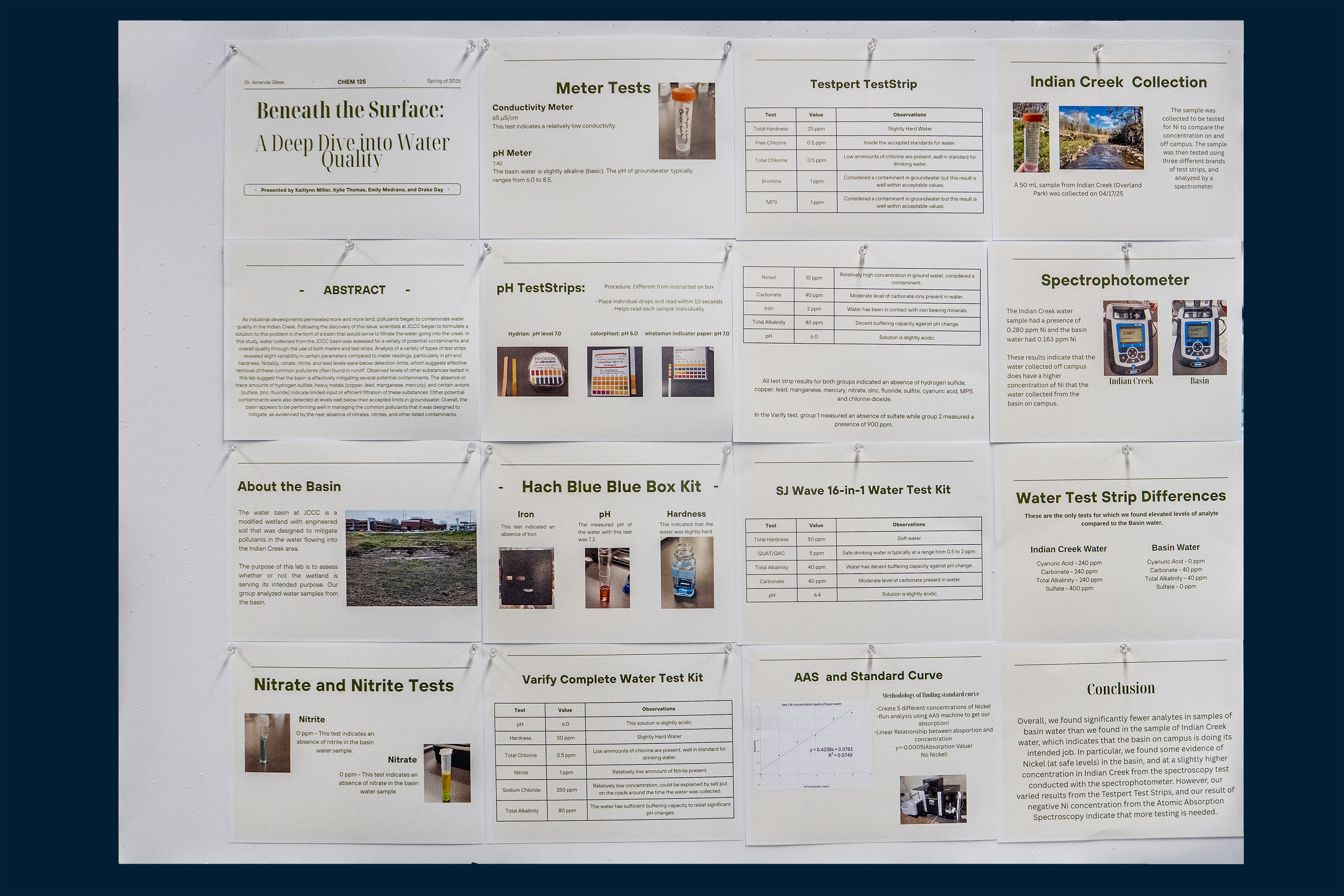
As industrial developments permeated more and more land, pollutants began to contaminate water quality in the Indian Creek. Following the discovery of this issue, scientists at JCCC began to formulate a solution to this problem in the form of a basin that would serve to filtrate the water going into the creek. In this study, water collected from the JCCC basin was assessed for a variety of potential contaminants and overall quality through the use of both meters and test strips. Analysis of a variety of types of test strips revealed slight variability in certain parameters compared to meter readings, particularly in pH and hardness. Notably, nitrate, nitrite, and lead levels were below detection limits, which suggests effective removal of these common pollutants often found in runoff. Observed levels of other substances tested in this lab suggest that the basin is effectively mitigating several potential contaminants. The absence or trace amounts of hydrogen sulfide, heavy metals (copper, lead, manganese, mercury), and certain anions (sulfate, zinc, fluoride) indicate limited input or efficient filtration of these substances. Other potential contaminants were also detected at levels well below their accepted limits in groundwater. Overall, the basin appears to be performing well in managing the common pollutants that it was designed to mitigate as evidenced by the near absence of nitrates, nitrites, and other listed contaminants.
Image
Beneath the Surface: A Deep Dive into Water Quality
CoLab, COM 100
As industrial developments permeated more and more land, pollutants began to contaminate water quality in the Indian Creek. Following the discovery of this issue, scientists at JCCC began to formulate a solution to this problem in the form of a basin that would serve to filtrate the water going into the creek. In this study, water collected from the JCCC basin was assessed for a variety of potential contaminants and overall quality through the use of both meters and test strips. Analysis of a variety of types of test strips revealed slight variability in certain parameters compared to meter readings, particularly in pH and hardness. Notably, nitrate, nitrite, and lead levels were below detection limits, which suggests effective removal of these common pollutants often found in runoff. Observed levels of other substances tested in this lab suggest that the basin is effectively mitigating several potential contaminants. The absence or trace amounts of hydrogen sulfide, heavy metals (copper, lead, manganese, mercury), and certain anions (sulfate, zinc, fluoride) indicate limited input or efficient filtration of these substances. Other potential contaminants were also detected at levels well below their accepted limits in groundwater. Overall, the basin appears to be performing well in managing the common pollutants that it was designed to mitigate as evidenced by the near absence of nitrates, nitrites, and other listed contaminants.
Comments
The faculty mentor for this project was Amanda Glass, Chemistry.