

Location
CoLab, COM 100
Start Date
1-5-2025 2:45 PM
Document Type
Poster
Description
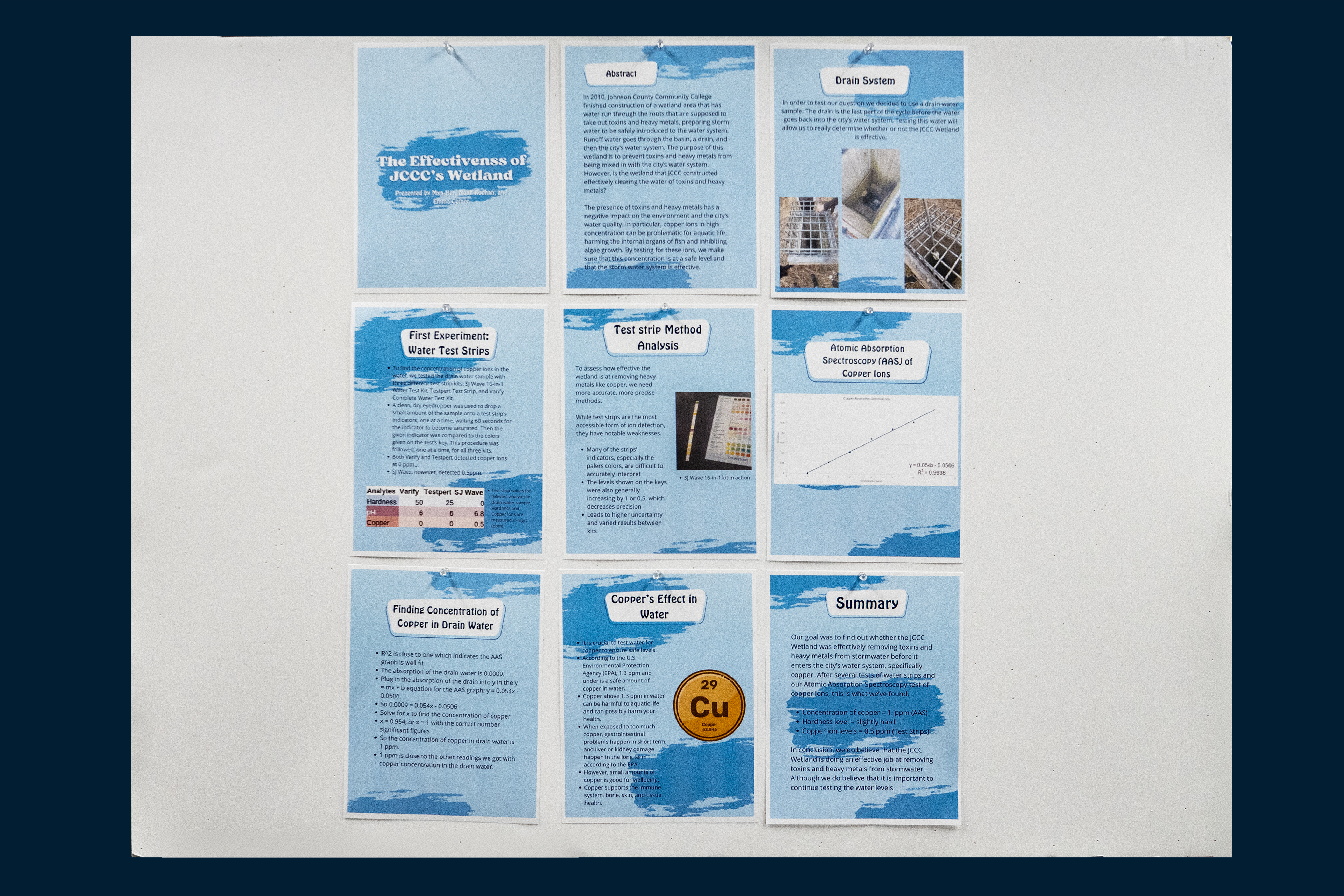
In 2010, Johnson County Community College finished construction of a wetland area that has water run through the roots that are supposed to take out toxins and heavy metals, preparing storm water to be safely introduced to the water system. Runoff water goes through the basin, a drain, and then the city’s water system. The purpose of this wetland is to prevent toxins and heavy metals from being mixed in with the city’s water system. However, is the wetland that JCCC constructed effectively clearing the water of toxins and heavy metals? The presence of toxins and heavy metals has a negative impact on the environment and the city’s water quality. In particular, copper ions in high concentration can be problematic for aquatic life, harming the internal organs of fish and inhibiting algae growth. By testing for these ions, we make sure that this concentration is at a safe level and that the storm water system is effective. In order to test this, we sampled water from the system’s drain. We’ve found the water to be slightly hard, and copper ions were found to be 0.5mg/L.
Image
The Effectiveness of JCCC's Wetland in Clearing Toxins and Heavy Metals
CoLab, COM 100
In 2010, Johnson County Community College finished construction of a wetland area that has water run through the roots that are supposed to take out toxins and heavy metals, preparing storm water to be safely introduced to the water system. Runoff water goes through the basin, a drain, and then the city’s water system. The purpose of this wetland is to prevent toxins and heavy metals from being mixed in with the city’s water system. However, is the wetland that JCCC constructed effectively clearing the water of toxins and heavy metals? The presence of toxins and heavy metals has a negative impact on the environment and the city’s water quality. In particular, copper ions in high concentration can be problematic for aquatic life, harming the internal organs of fish and inhibiting algae growth. By testing for these ions, we make sure that this concentration is at a safe level and that the storm water system is effective. In order to test this, we sampled water from the system’s drain. We’ve found the water to be slightly hard, and copper ions were found to be 0.5mg/L.
Comments
The faculty mentor for this project was Amanda Glass, Chemistry.