

Location
CoLab, COM 100
Start Date
1-5-2025 8:30 AM
Document Type
Poster
Description
The urgent need for new antimicrobial compounds is underscored by the rise of antibiotic-resistant infections. As part of the Tiny Earth Project, this research focused on finding and classifying antibiotic producing bacteria that can be sourced from soil. A loamy clay-like sample was gathered from an open field, well lit region and was sub cultured through serial dilution on 50% Tryptic Soy Agar (TSA) plates. The selected colonies were picked from the master plate and tested against non pathogenic relatives of ESKAPE pathogens. Through initial testing, Candidate # 11 demonstrated the strongest inhibition of Escherichia coli, Staphylococcus epidermidis, and Enterococcus faecalis suggesting the ability for broad spectrum antimicrobial action. In order to better characterize the isolate simple staining, gram staining, endospore staining and acid fast staining was conducted. Analysis revealed that Candidate #11 was gram negative, rod shaped, non-endosporic as well as non-acid fast, indicating the absence of mycolic acid and spores. With the preliminary data Candidate #11 possesses unique features as to its shape and cells alongside its antimicrobial activity which would be interesting to study further in future biochemical and genetic studies. This research reinforces the potential of soil microbiomes to provide novel antibiotics and showcases the scope undergraduate research has in combating the systemic crisis of antibiotic resistance.
Image
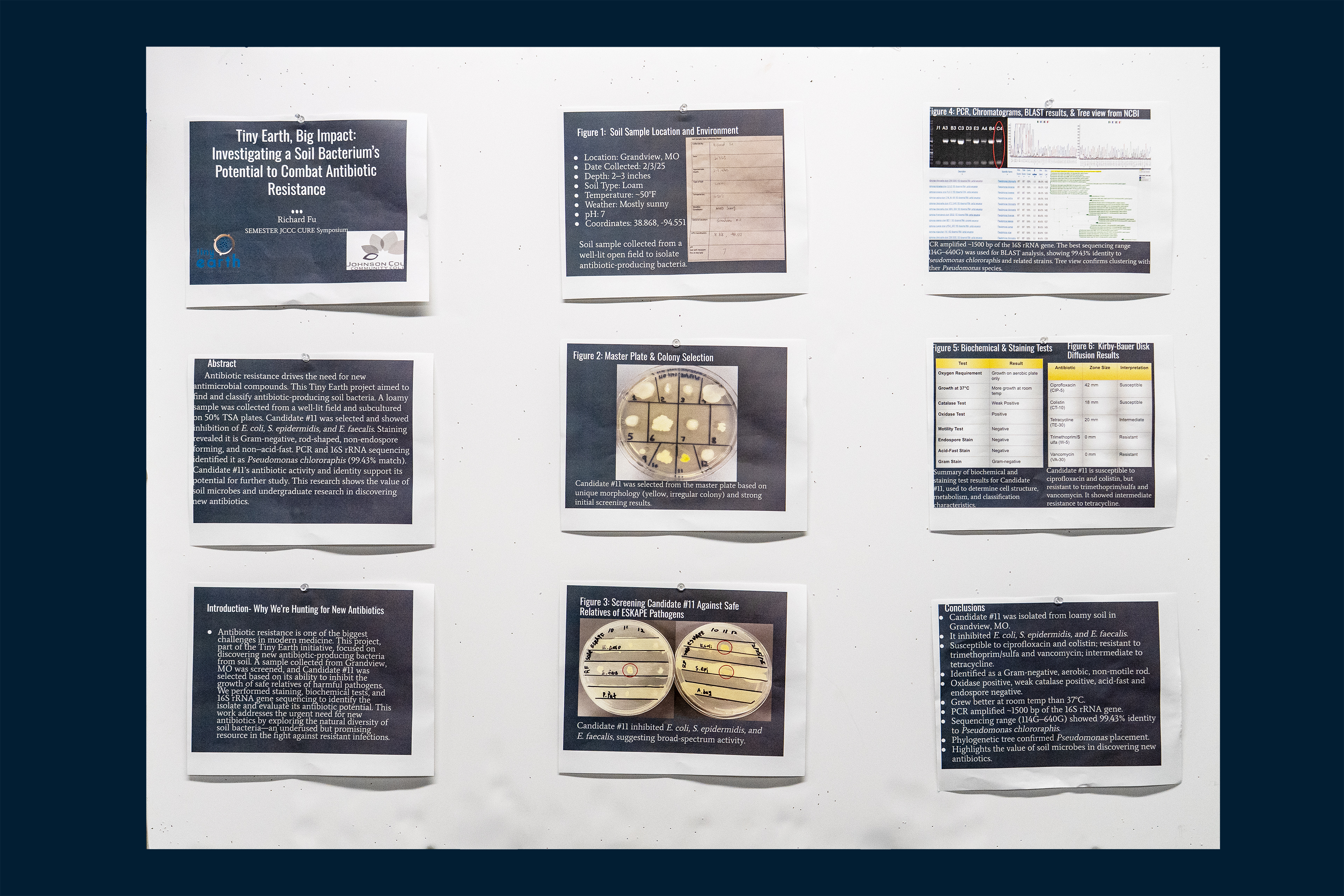
Tiny Earth, Big Impact: Investigating a Soil Bacterium’s Potential to Combat Antibiotic Resistance
CoLab, COM 100
The urgent need for new antimicrobial compounds is underscored by the rise of antibiotic-resistant infections. As part of the Tiny Earth Project, this research focused on finding and classifying antibiotic producing bacteria that can be sourced from soil. A loamy clay-like sample was gathered from an open field, well lit region and was sub cultured through serial dilution on 50% Tryptic Soy Agar (TSA) plates. The selected colonies were picked from the master plate and tested against non pathogenic relatives of ESKAPE pathogens. Through initial testing, Candidate # 11 demonstrated the strongest inhibition of Escherichia coli, Staphylococcus epidermidis, and Enterococcus faecalis suggesting the ability for broad spectrum antimicrobial action. In order to better characterize the isolate simple staining, gram staining, endospore staining and acid fast staining was conducted. Analysis revealed that Candidate #11 was gram negative, rod shaped, non-endosporic as well as non-acid fast, indicating the absence of mycolic acid and spores. With the preliminary data Candidate #11 possesses unique features as to its shape and cells alongside its antimicrobial activity which would be interesting to study further in future biochemical and genetic studies. This research reinforces the potential of soil microbiomes to provide novel antibiotics and showcases the scope undergraduate research has in combating the systemic crisis of antibiotic resistance.
Comments
The faculty mentor for this project was Eulandria Biddle, Biology.