

Location
CoLab, COM 100
Start Date
1-5-2025 1:30 PM
Document Type
Poster
Description
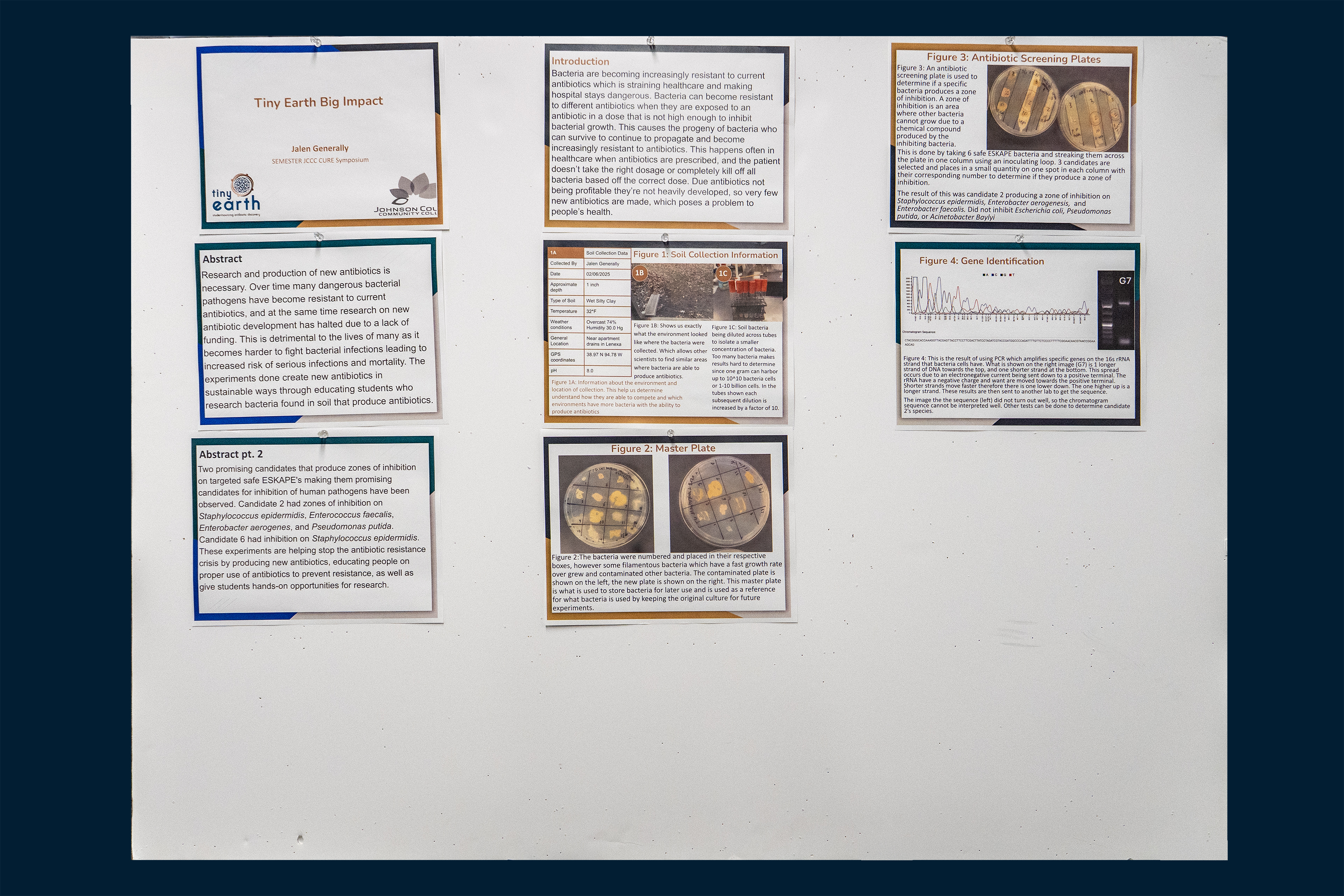
Research and production of new antibiotics is necessary. Over time many dangerous bacterial pathogens have become resistant to current antibiotics, and at the same time research on new antibiotic development has halted due to a lack of funding. This is detrimental to the lives of many as it becomes harder to fight bacterial infections leading to increased risk of serious infections and mortality. The experiments done create new antibiotics in sustainable ways through educating students who research bacteria found in soil that produce antibiotics. Two promising candidates that produce zones of inhibition on targeted safe ESKAPE's making them promising candidates for inhibition of human pathogens have been observed. Candidate 2 had zones of inhibition on S. epidermis, E. faecalis, E aerogenes, and P putida. Candidate 6 had inhibition on S. epidermis. These experiments are helping stop the antibiotic resistance crisis by producing new antibiotics, educating people on proper use of antibiotics to prevent resistance, as well as give students hands-on opportunities for research.
Image
Tiny Earth
CoLab, COM 100
Research and production of new antibiotics is necessary. Over time many dangerous bacterial pathogens have become resistant to current antibiotics, and at the same time research on new antibiotic development has halted due to a lack of funding. This is detrimental to the lives of many as it becomes harder to fight bacterial infections leading to increased risk of serious infections and mortality. The experiments done create new antibiotics in sustainable ways through educating students who research bacteria found in soil that produce antibiotics. Two promising candidates that produce zones of inhibition on targeted safe ESKAPE's making them promising candidates for inhibition of human pathogens have been observed. Candidate 2 had zones of inhibition on S. epidermis, E. faecalis, E aerogenes, and P putida. Candidate 6 had inhibition on S. epidermis. These experiments are helping stop the antibiotic resistance crisis by producing new antibiotics, educating people on proper use of antibiotics to prevent resistance, as well as give students hands-on opportunities for research.
Comments
The faculty mentor for this project was Eulandria Biddle, Biology.