

Location
CoLab, COM 100
Start Date
1-5-2025 12:15 PM
Document Type
Poster
Description
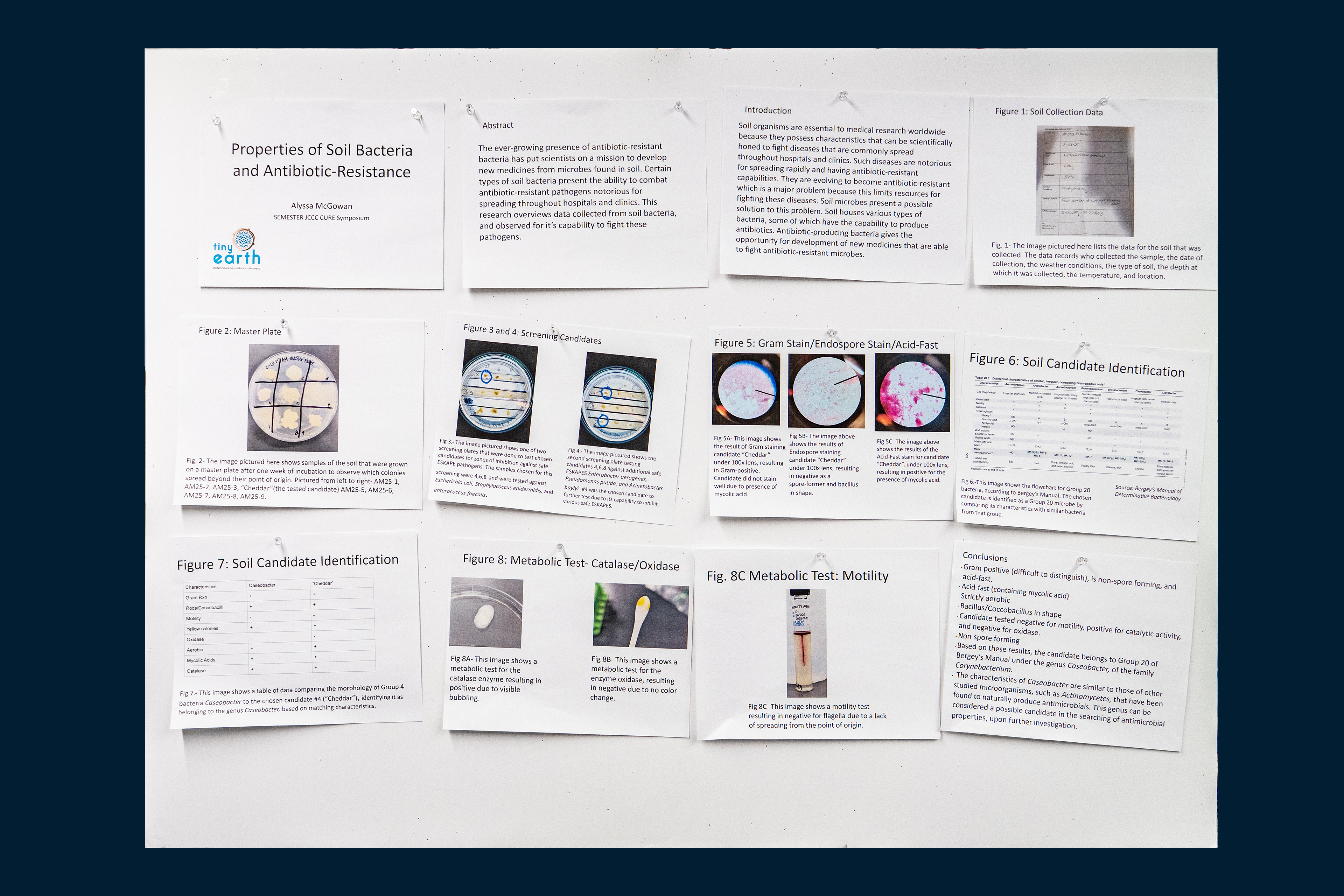
The Effect of Soil Bacteria Against ESKAPE Pathogens Over the past few decades, modern medicine has been in a constant battle against antibiotic-resistant pathogens. Insufficient funding for research on new bacteria and the overuse of antibiotics have led to more evolved antibiotic-resistant pathogens. Research organizations are crucial for providing resources to student scientists to conduct such research. The Tiny Earth program works with students to solve the problem of antibiotic resistance through soil data collection and experimentation. The goal of this research is to find a bacterial candidate that can be used against the antibiotic-resistant bacteria, specifically ESKAPE pathogens, which are notorious for spreading disease within medical settings. The collected soil was found to contain a type of Gram-positive bacteria that showed signs of inhibition when tested against safe ESKAPE bacteria in an in vitro environment. The candidate was able to strongly inhibit Escherichia. Coli, Enterobacter. aerogenes, and Acinetobacter. baylyi. This means that it could be a possible candidate to be used against ESKAPE pathogens, and there are potentially more candidates to be found.
Image
The Effect of Soil Bacteria Against ESKAPE Pathogens
CoLab, COM 100
The Effect of Soil Bacteria Against ESKAPE Pathogens Over the past few decades, modern medicine has been in a constant battle against antibiotic-resistant pathogens. Insufficient funding for research on new bacteria and the overuse of antibiotics have led to more evolved antibiotic-resistant pathogens. Research organizations are crucial for providing resources to student scientists to conduct such research. The Tiny Earth program works with students to solve the problem of antibiotic resistance through soil data collection and experimentation. The goal of this research is to find a bacterial candidate that can be used against the antibiotic-resistant bacteria, specifically ESKAPE pathogens, which are notorious for spreading disease within medical settings. The collected soil was found to contain a type of Gram-positive bacteria that showed signs of inhibition when tested against safe ESKAPE bacteria in an in vitro environment. The candidate was able to strongly inhibit Escherichia. Coli, Enterobacter. aerogenes, and Acinetobacter. baylyi. This means that it could be a possible candidate to be used against ESKAPE pathogens, and there are potentially more candidates to be found.
Comments
The faculty mentor for this project was Eulandria Biddle, Biology.