

Location
CoLab, COM 100
Start Date
1-5-2025 11:00 AM
Document Type
Poster
Description
Test project started with a soil sample taken from a neighborhood lawn. That sample was taken, diluted, and placed on agar plates for bacteria to grow. On those plates, zones of inhibition were visible, areas where the bacteria was inhibiting other species from growing. These zones show specific bacteria that are showing signs of producing antibiotics. 12 bacteria with the best zones of inhibitor were selected and tested them against the safe relatives of medically significant pathogens: Enterobacter aerogenes, Staphylococcus epidermidis, Escherichia coli, Pseudomonas putida, Enteroccous faceilis, Ancinetobacter baylyi. Each safe relative was spread onto an agar plate, fully covering it, with each of the 12 selected bacteria placed on the same plate. From there, one bacteria was found that had shown a zone of inhibition on two of the safe relatives; Staphylococcus epidermidis and Enteroccocus faceilis. From here, metabolic testing, PCR, and gel electrophoresis will be used to identify the species of bacteria.
Image
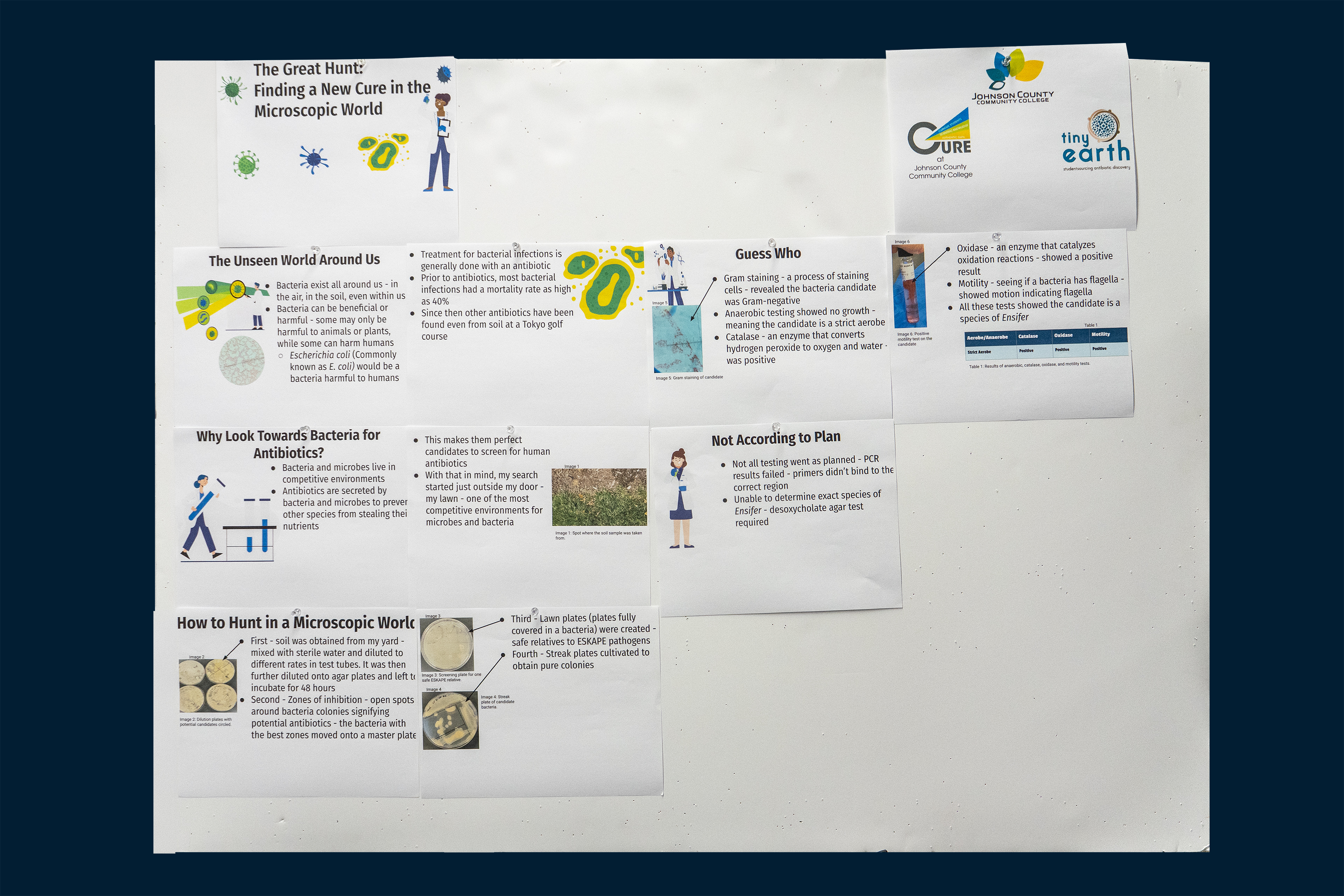
The Great Hunt: Finding a New Cure in the Microscopic World
CoLab, COM 100
Test project started with a soil sample taken from a neighborhood lawn. That sample was taken, diluted, and placed on agar plates for bacteria to grow. On those plates, zones of inhibition were visible, areas where the bacteria was inhibiting other species from growing. These zones show specific bacteria that are showing signs of producing antibiotics. 12 bacteria with the best zones of inhibitor were selected and tested them against the safe relatives of medically significant pathogens: Enterobacter aerogenes, Staphylococcus epidermidis, Escherichia coli, Pseudomonas putida, Enteroccous faceilis, Ancinetobacter baylyi. Each safe relative was spread onto an agar plate, fully covering it, with each of the 12 selected bacteria placed on the same plate. From there, one bacteria was found that had shown a zone of inhibition on two of the safe relatives; Staphylococcus epidermidis and Enteroccocus faceilis. From here, metabolic testing, PCR, and gel electrophoresis will be used to identify the species of bacteria.
Comments
The faculty mentor for this project was Melissa Beaty, Biology.