

Location
CoLab, OCB 100
Start Date
25-4-2024 9:00 AM
Document Type
Poster
Description
Abstract Freeze-dried products have long been a favored method for preserving food and reducing weight by removing water. Unfortunately, freeze-drying food regularly results in a substantial difference in taste between fresh and freeze-dried products. The present study attempted to find differences between a freeze-dried and a fresh sample of borscht. Thin-layer chromatography was carried out on the fresh sample of borscht to identify the efficacy of the extraction agent. Methylene chloride was used to extract both samples and gas chromatography-mass spectroscopy (GC/MS) was used to analyze the extract. GC/MS revealed substantial decreases in certain compounds, including Hexa-2,4-diyn-1-ylbenzene, a component of tarragon and one of many possible causes for the change in flavor. Other major differences between the fresh and freeze-dried products will be discussed below.
Image
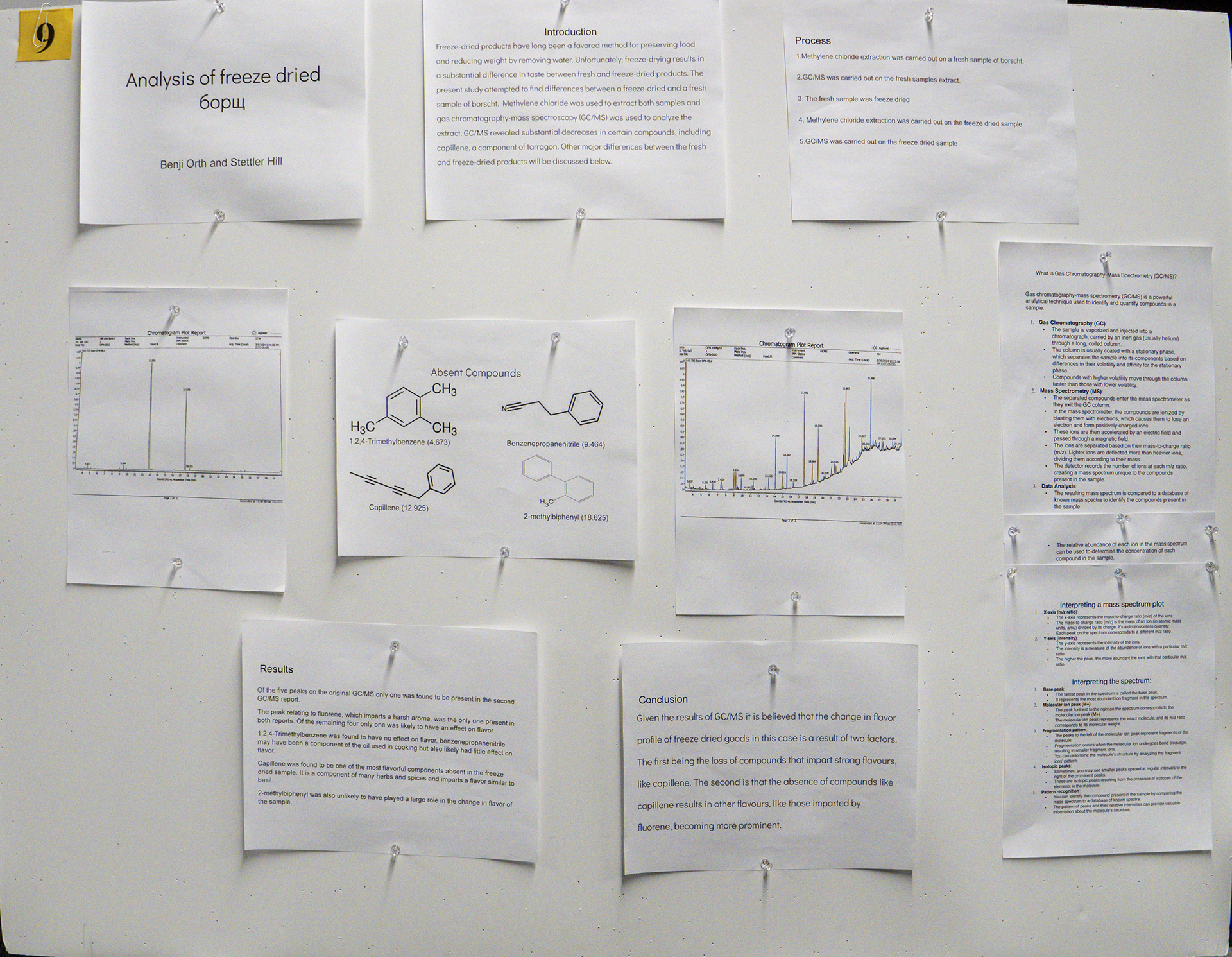
Substantial Differences Between Freeze Dried and Fresh Borscht
CoLab, OCB 100
Abstract Freeze-dried products have long been a favored method for preserving food and reducing weight by removing water. Unfortunately, freeze-drying food regularly results in a substantial difference in taste between fresh and freeze-dried products. The present study attempted to find differences between a freeze-dried and a fresh sample of borscht. Thin-layer chromatography was carried out on the fresh sample of borscht to identify the efficacy of the extraction agent. Methylene chloride was used to extract both samples and gas chromatography-mass spectroscopy (GC/MS) was used to analyze the extract. GC/MS revealed substantial decreases in certain compounds, including Hexa-2,4-diyn-1-ylbenzene, a component of tarragon and one of many possible causes for the change in flavor. Other major differences between the fresh and freeze-dried products will be discussed below.
Comments
The faculty mentor for this project was Todd Watson, Chemistry.