

Location
CoLab, OCB 100
Start Date
25-4-2024 10:30 AM
Document Type
Poster
Description
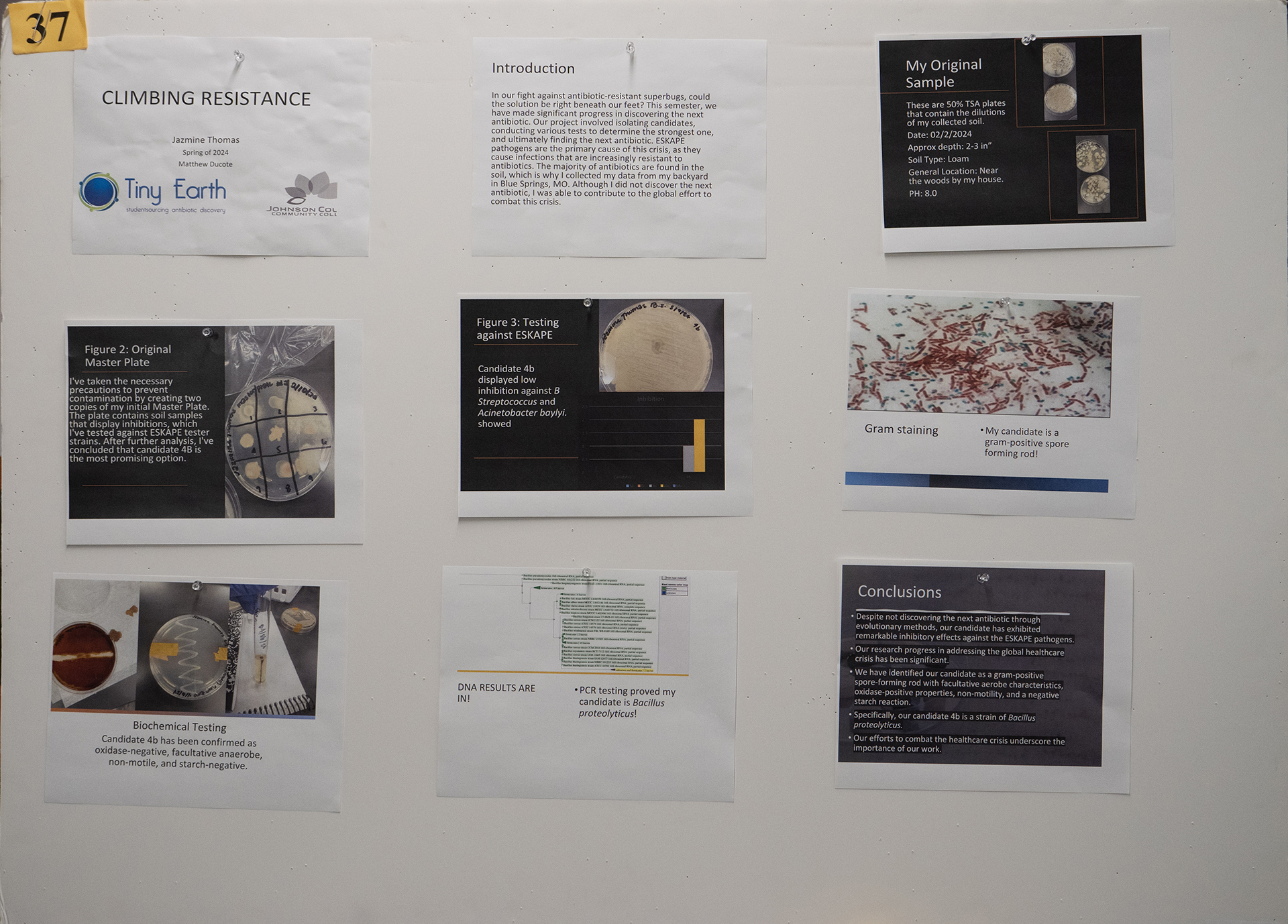
Antibiotics are a vital component of our health as humans because of their ability to treat diseases and infections caused by bacteria. Since the 1960s, there's been widespread antibiotic resistance, which is one of the most significant risks to our healthcare system. We must discover new antibiotics; our soil is the easiest way to find these new antibiotics. In this experiment, we diluted soil samples to obtain a countable plate. Safe relatives of the ESKAPE pathogens tested against our candidates, and my candidate 4b showed inhibition to Enterobacter aerogenes and Bacillus subtilis. We made a series of streak plates to obtain a pure culture. After undergoing a spore stain, my candidate is a rod-shaped positive gram, forming spores. After screening for potential antibiotics, our final candidate, 4b, underwent PCR (polymerase chain reaction) sequencing. Copies of target DNA are used in gel electrophoresis to identify the candidate organism and its ability to become an antibiotic likely to avoid the development of resistance.
Image
Climbing Resistance
CoLab, OCB 100
Antibiotics are a vital component of our health as humans because of their ability to treat diseases and infections caused by bacteria. Since the 1960s, there's been widespread antibiotic resistance, which is one of the most significant risks to our healthcare system. We must discover new antibiotics; our soil is the easiest way to find these new antibiotics. In this experiment, we diluted soil samples to obtain a countable plate. Safe relatives of the ESKAPE pathogens tested against our candidates, and my candidate 4b showed inhibition to Enterobacter aerogenes and Bacillus subtilis. We made a series of streak plates to obtain a pure culture. After undergoing a spore stain, my candidate is a rod-shaped positive gram, forming spores. After screening for potential antibiotics, our final candidate, 4b, underwent PCR (polymerase chain reaction) sequencing. Copies of target DNA are used in gel electrophoresis to identify the candidate organism and its ability to become an antibiotic likely to avoid the development of resistance.
Comments
The faculty mentor for this project was Matthew Ducote, Biology.