

Location
CoLab, OCB 100
Start Date
25-4-2024 10:30 AM
Document Type
Poster
Description
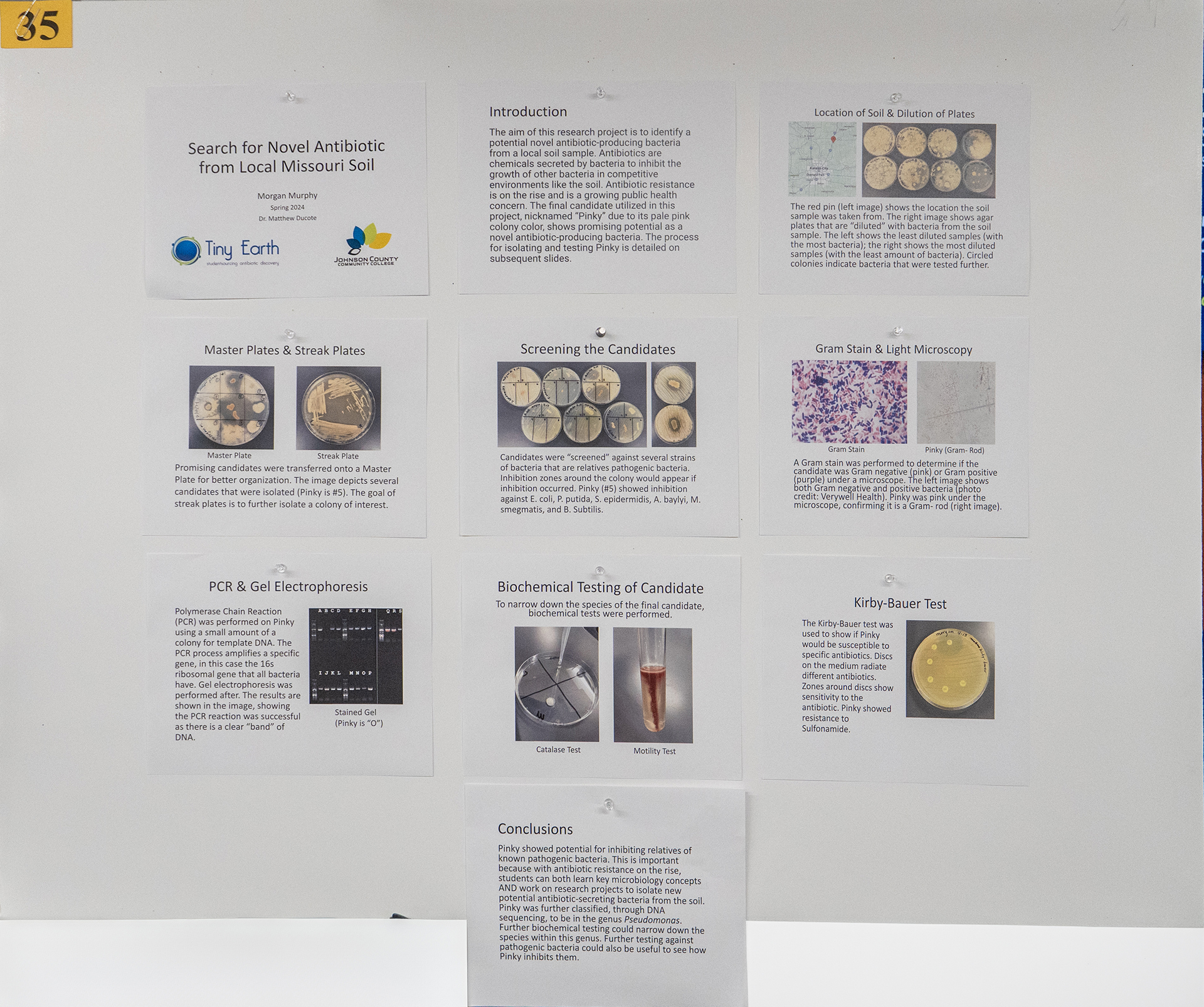
The aim of this research project is to identify a potential novel antibiotic-producing bacteria from local soil samples from a wooded area of Northwest Missouri. Antibiotics are chemicals secreted by bacteria to inhibit the growth of other bacteria in competitive environments like the soil. Antibiotic resistance is on the rise, as warned by Andrew Fleming who discovered the first antibiotic (penicillin), and is a growing public health concern. The final candidate utilized in this project, nicknamed Pinky due to its pale pink colony color, was tested against several strains of ESKAPE pathogen relatives and was found to be effective against E. coli, P. putida, S. epidermidis, A. baylyi, M. smegmatis, and B. subtilis. Pinky shows promising potential as a novel antibiotic-producing bacteria. Microbiology techniques used include creation of master, streak, and screening plates, light microscopy, differential staining (particularly the Gram stain), aseptic technique, serial dilutions, PCR testing of the 16s gene, and biochemical testing. These techniques allowed for isolating the candidate, testing it against various other bacteria for inhibition, and DNA sequencing to assess the species of the bacteria and its relation to other bacteria.
Image
Search for Novel Antibiotic from Local Missouri Soil
CoLab, OCB 100
The aim of this research project is to identify a potential novel antibiotic-producing bacteria from local soil samples from a wooded area of Northwest Missouri. Antibiotics are chemicals secreted by bacteria to inhibit the growth of other bacteria in competitive environments like the soil. Antibiotic resistance is on the rise, as warned by Andrew Fleming who discovered the first antibiotic (penicillin), and is a growing public health concern. The final candidate utilized in this project, nicknamed Pinky due to its pale pink colony color, was tested against several strains of ESKAPE pathogen relatives and was found to be effective against E. coli, P. putida, S. epidermidis, A. baylyi, M. smegmatis, and B. subtilis. Pinky shows promising potential as a novel antibiotic-producing bacteria. Microbiology techniques used include creation of master, streak, and screening plates, light microscopy, differential staining (particularly the Gram stain), aseptic technique, serial dilutions, PCR testing of the 16s gene, and biochemical testing. These techniques allowed for isolating the candidate, testing it against various other bacteria for inhibition, and DNA sequencing to assess the species of the bacteria and its relation to other bacteria.
Comments
The faculty mentor for this project was Matthew Ducote, Biology.