

Location
CoLab, OCB 100
Start Date
25-4-2024 10:30 AM
Document Type
Poster
Description
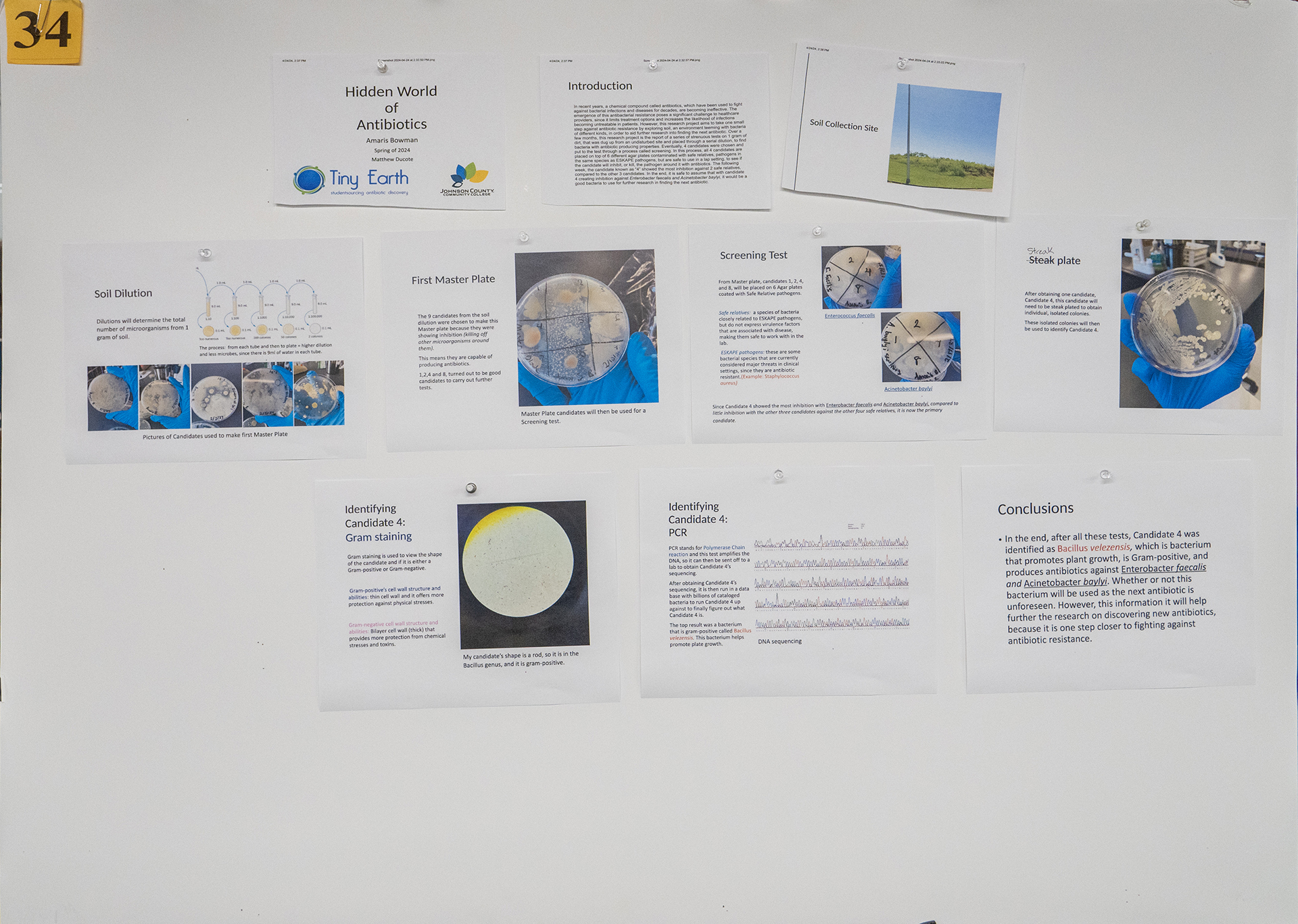
In recent years, chemical compounds called antibiotics, which have been used to fight against bacterial infections and diseases for decades, have become ineffective. The emergence of antibacterial resistance poses a significant challenge to healthcare providers, since it limits treatment options and increases the likelihood of infections becoming untreatable in patients. In order to address antibiotic resistance, this project aims to investigate soil, an environment that contains a variety of bacteria, in order to aid future research into the discovery of a new antibiotic. In this research project, a gram of dirt was collected from an undisturbed site and placed through a series of dilutions to detect bacteria that produce antibiotics. Through a process known as screening, four candidates were selected and put to the test. In this process, all 4 candidates are placed on top of 6 different agar plates contaminated with safe relatives, pathogens in the same species as ESKAPE pathogens, but are safe to use in a lap setting, to see if the candidate will inhibit, or kill, the pathogen around it with antibiotics. The following week, the candidate known as “4” showed the most inhibition against 2 safe relatives, compared to the other 3 candidates. In the end, it is safe to assume that with candidate 4 creating inhibition against Enterobacter faecalis and Acinetobacter baylyi, it would be a good candidate to use for further research in finding the next antibiotic.
Image
The Hidden World of Antibiotics
CoLab, OCB 100
In recent years, chemical compounds called antibiotics, which have been used to fight against bacterial infections and diseases for decades, have become ineffective. The emergence of antibacterial resistance poses a significant challenge to healthcare providers, since it limits treatment options and increases the likelihood of infections becoming untreatable in patients. In order to address antibiotic resistance, this project aims to investigate soil, an environment that contains a variety of bacteria, in order to aid future research into the discovery of a new antibiotic. In this research project, a gram of dirt was collected from an undisturbed site and placed through a series of dilutions to detect bacteria that produce antibiotics. Through a process known as screening, four candidates were selected and put to the test. In this process, all 4 candidates are placed on top of 6 different agar plates contaminated with safe relatives, pathogens in the same species as ESKAPE pathogens, but are safe to use in a lap setting, to see if the candidate will inhibit, or kill, the pathogen around it with antibiotics. The following week, the candidate known as “4” showed the most inhibition against 2 safe relatives, compared to the other 3 candidates. In the end, it is safe to assume that with candidate 4 creating inhibition against Enterobacter faecalis and Acinetobacter baylyi, it would be a good candidate to use for further research in finding the next antibiotic.
Comments
The faculty mentor for this project was Matthew Ducote, Biology.