

Location
CoLab, OCB 100
Start Date
25-4-2024 10:30 AM
Document Type
Poster
Description
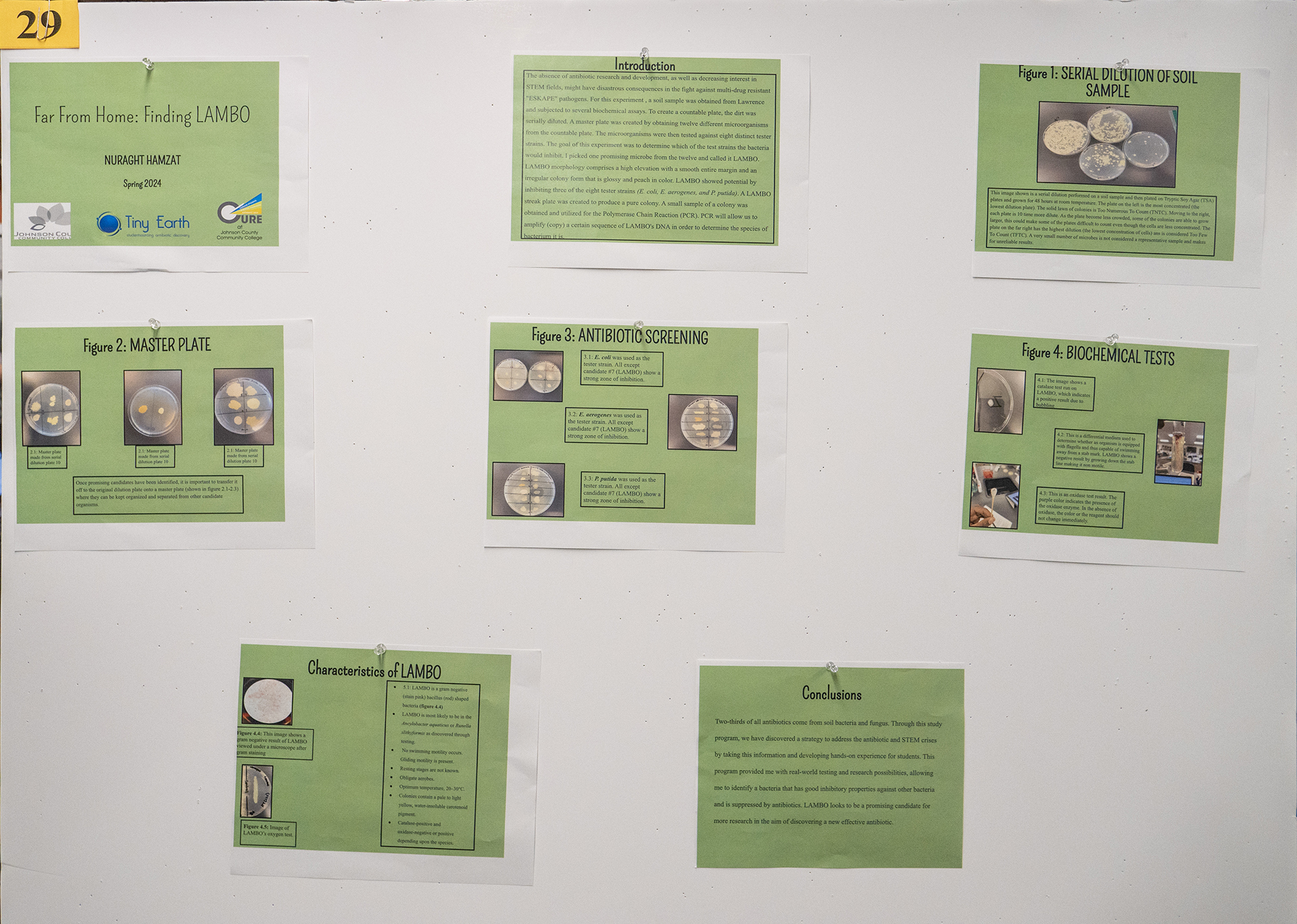
The absence of antibiotic research and development, as well as decreasing interest in STEM fields, might have disastrous consequences in the fight against multi-drug resistant "ESKAPE" pathogens. For this experiment , a soil sample was obtained from Lawrence and subjected to several biochemical assays. To create a countable plate, the dirt was serially diluted. A master plate was created by obtaining twelve different microorganisms from the countable plate. The microorganisms were then tested against eight distinct tester strains. The goal of this experiment was to determine which of the test strains the bacteria would inhibit. I picked one promising microbe from the twelve and called it LAMBO. LAMBO morphology comprises a high elevation with a smooth entire margin and an irregular colony form that is glossy and peach in color. LAMBO showed potential by inhibiting three of the eight tester strains (E. coli, E. aerogenes, and P. putida). A LAMBO streak plate was created to produce a pure colony. A small sample of a colony was obtained and utilized for the Polymerase Chain Reaction (PCR). PCR will allow us to amplify (copy) a certain sequence of LAMBO's DNA in order to determine the species of bacterium it is.
Image
Far Away from Home: Finding LAMBO
CoLab, OCB 100
The absence of antibiotic research and development, as well as decreasing interest in STEM fields, might have disastrous consequences in the fight against multi-drug resistant "ESKAPE" pathogens. For this experiment , a soil sample was obtained from Lawrence and subjected to several biochemical assays. To create a countable plate, the dirt was serially diluted. A master plate was created by obtaining twelve different microorganisms from the countable plate. The microorganisms were then tested against eight distinct tester strains. The goal of this experiment was to determine which of the test strains the bacteria would inhibit. I picked one promising microbe from the twelve and called it LAMBO. LAMBO morphology comprises a high elevation with a smooth entire margin and an irregular colony form that is glossy and peach in color. LAMBO showed potential by inhibiting three of the eight tester strains (E. coli, E. aerogenes, and P. putida). A LAMBO streak plate was created to produce a pure colony. A small sample of a colony was obtained and utilized for the Polymerase Chain Reaction (PCR). PCR will allow us to amplify (copy) a certain sequence of LAMBO's DNA in order to determine the species of bacterium it is.
Comments
The faculty mentor for this project was Jaime Cunningham, Biology.