

Location
CoLab, OCB 100
Start Date
25-4-2024 9:00 AM
Document Type
Poster
Description
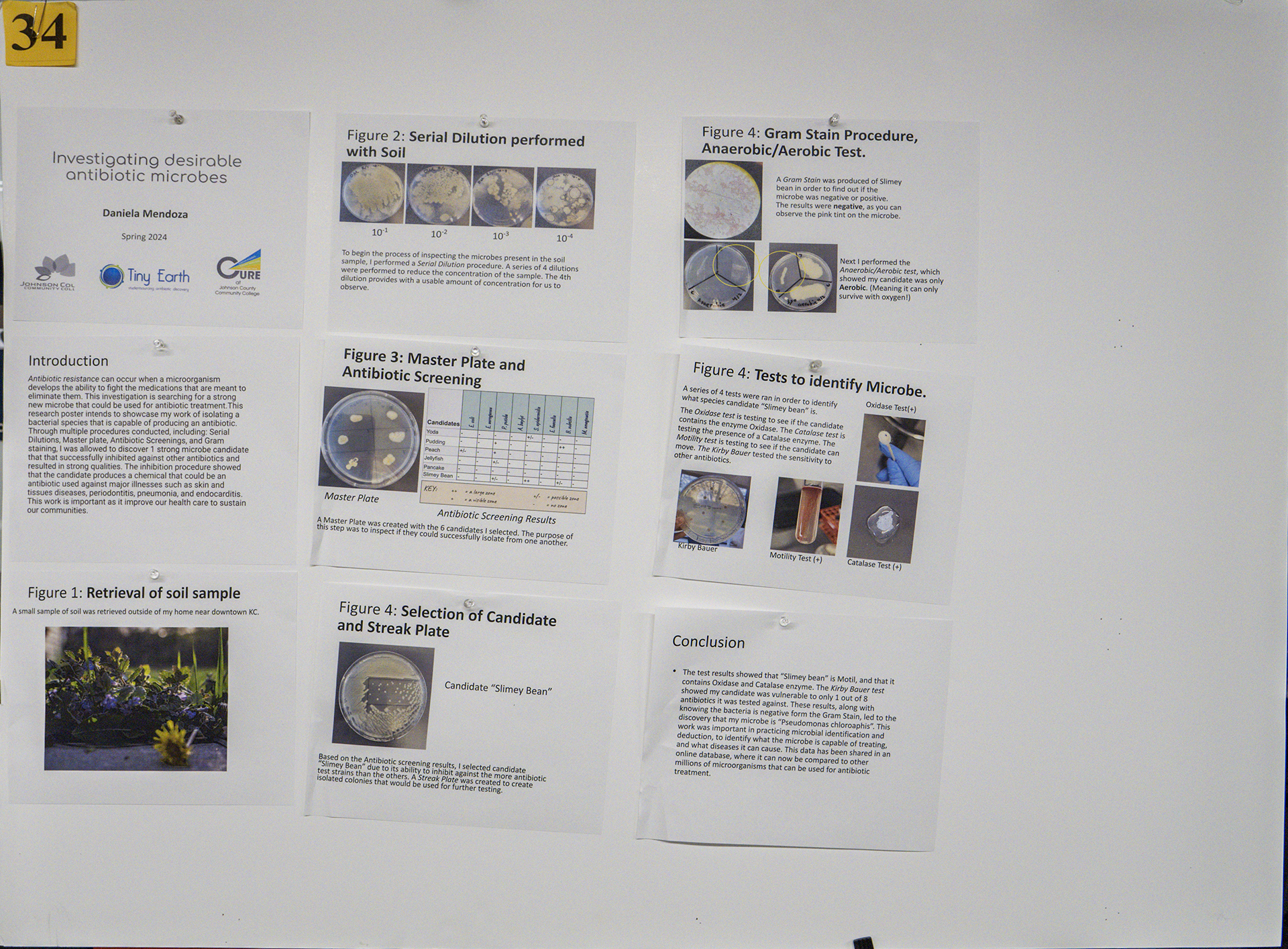
Antibiotic resistance can occur when a microbe, more commonly known as a germ, develops the ability to fight the medications that are meant to eliminate them. This phenomenon causes a global health risk, as it can be extremely problematic to treat an ill individual who is needing medical assistance. Researchers are eager to search for new microbes that can assist with expanding the amount of antibiotics available to the public. This research poster intends to showcase my work of isolating a bacterial species capable of producing an antibiotic. The soil was collected in Kansas City and brought into the lab to perform a serial dilution. The serial dilution allowed for the isolation of the millions of microbes that were present in the soil. A Master plate was then created with desirable candidates that could successfully isolate from every other candidate. Each of the 6 successful candidates were obtained. These candidates were screened to observe its ability to achieve inhibition in 8 different safe relative tester species. When the candidates were screened, 1 candidate produced the most inhibition when grown with the tester strains. Candidate “Slimey Bean” produced inhibition in three tester strains, these included: Pseudomonas putida, Staphylococcus epidermidis, and Bacillus subtilis. This inhibition demonstrates the ability for this microbe strain to be able to produce a chemical that could be an antibiotic used against major illnesses including skin and tissues diseases, periodontitis, pneumonia, and endocarditis.
Image
Investigating Desirable Antibiotic Microbes
CoLab, OCB 100
Antibiotic resistance can occur when a microbe, more commonly known as a germ, develops the ability to fight the medications that are meant to eliminate them. This phenomenon causes a global health risk, as it can be extremely problematic to treat an ill individual who is needing medical assistance. Researchers are eager to search for new microbes that can assist with expanding the amount of antibiotics available to the public. This research poster intends to showcase my work of isolating a bacterial species capable of producing an antibiotic. The soil was collected in Kansas City and brought into the lab to perform a serial dilution. The serial dilution allowed for the isolation of the millions of microbes that were present in the soil. A Master plate was then created with desirable candidates that could successfully isolate from every other candidate. Each of the 6 successful candidates were obtained. These candidates were screened to observe its ability to achieve inhibition in 8 different safe relative tester species. When the candidates were screened, 1 candidate produced the most inhibition when grown with the tester strains. Candidate “Slimey Bean” produced inhibition in three tester strains, these included: Pseudomonas putida, Staphylococcus epidermidis, and Bacillus subtilis. This inhibition demonstrates the ability for this microbe strain to be able to produce a chemical that could be an antibiotic used against major illnesses including skin and tissues diseases, periodontitis, pneumonia, and endocarditis.
Comments
The faculty mentor for this project was Jaime Cunningham, Biology.