

Location
CoLab, OCB 100
Start Date
25-4-2024 6:00 PM
Document Type
Poster
Description
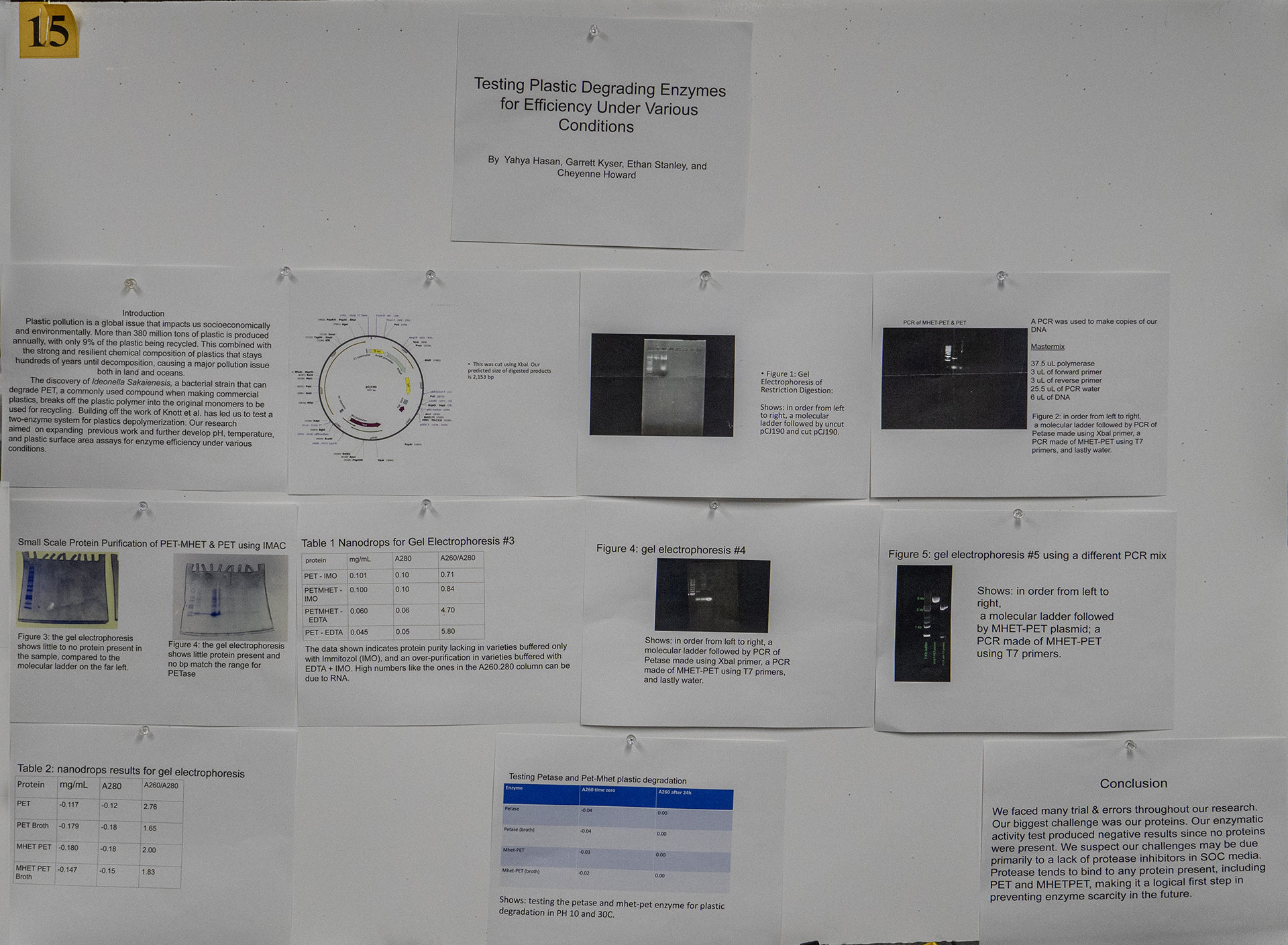
Plastic pollution is a global issue that impacts us socioeconomically and environmentally. More than 380 million tons of plastic is produced annually, with only 9% of the plastic being recycled. This combined with the strong and resilient chemical composition of plastics that stays hundreds of years until decomposition, causes a major pollution issue both in land and oceans. The discovery of Ideonella Sakenesis, a bacterial strain that can degrade PET, a commonly used compound when making commercial plastics, breaks off the plastic polymer into the original monomers to be used for recycling. Building off the work of Knott et al. has led us to test a two-enzyme system for plastics depolymerization. Our research will continue on previous work and further test pH, temperature, and plastic surface area for enzyme efficiency under various conditions.
Image
Testing Plastic Degrading Enzymes for Efficiency Under Various Conditions
CoLab, OCB 100
Plastic pollution is a global issue that impacts us socioeconomically and environmentally. More than 380 million tons of plastic is produced annually, with only 9% of the plastic being recycled. This combined with the strong and resilient chemical composition of plastics that stays hundreds of years until decomposition, causes a major pollution issue both in land and oceans. The discovery of Ideonella Sakenesis, a bacterial strain that can degrade PET, a commonly used compound when making commercial plastics, breaks off the plastic polymer into the original monomers to be used for recycling. Building off the work of Knott et al. has led us to test a two-enzyme system for plastics depolymerization. Our research will continue on previous work and further test pH, temperature, and plastic surface area for enzyme efficiency under various conditions.
Comments
The faculty mentor for this project was Heather Seitz, Biology.