

Location
CoLab, OCB 100
Start Date
25-4-2024 6:00 PM
Document Type
Poster
Description
Cancer remains a leading cause of mortality worldwide, necessitating the exploration of novel therapeutic agents. Although their application has been minimally explored in this context, chromoproteins (CPs) have been considered for their theoretical potential as anti-cancer compounds. This study aims to characterize a specific chromoprotein's effectiveness as an anti-cancer agent across a cancer cell line and evaluate its tolerance to differing pH levels, an essential factor for its stability and functionality in physiological conditions. Building on the limited existing research on CPs in cancer therapy, our work involves the cultivation and purification of the chosen CP, followed by assessments of its cytotoxic effects on a cancer cell line. Furthermore, we investigate the CP's structural and functional stability across a range of pH levels, reflecting the diverse microenvironments encountered within the human body. Despite the challenges inherent in pioneering new treatments, we remain hopeful that further research will unveil the conditions under which chromoproteins (CPs) might exhibit beneficial effects against cancer cells. Our ongoing studies aim to explore the nuanced interplay between CPs and various cellular environments, including the impact of pH variability, to uncover potential therapeutic applications. While preliminary data have yet to definitively prove the efficacy of CPs in cancer treatment, the theoretical potential of these compounds provides a compelling basis for continued investigation.
Image
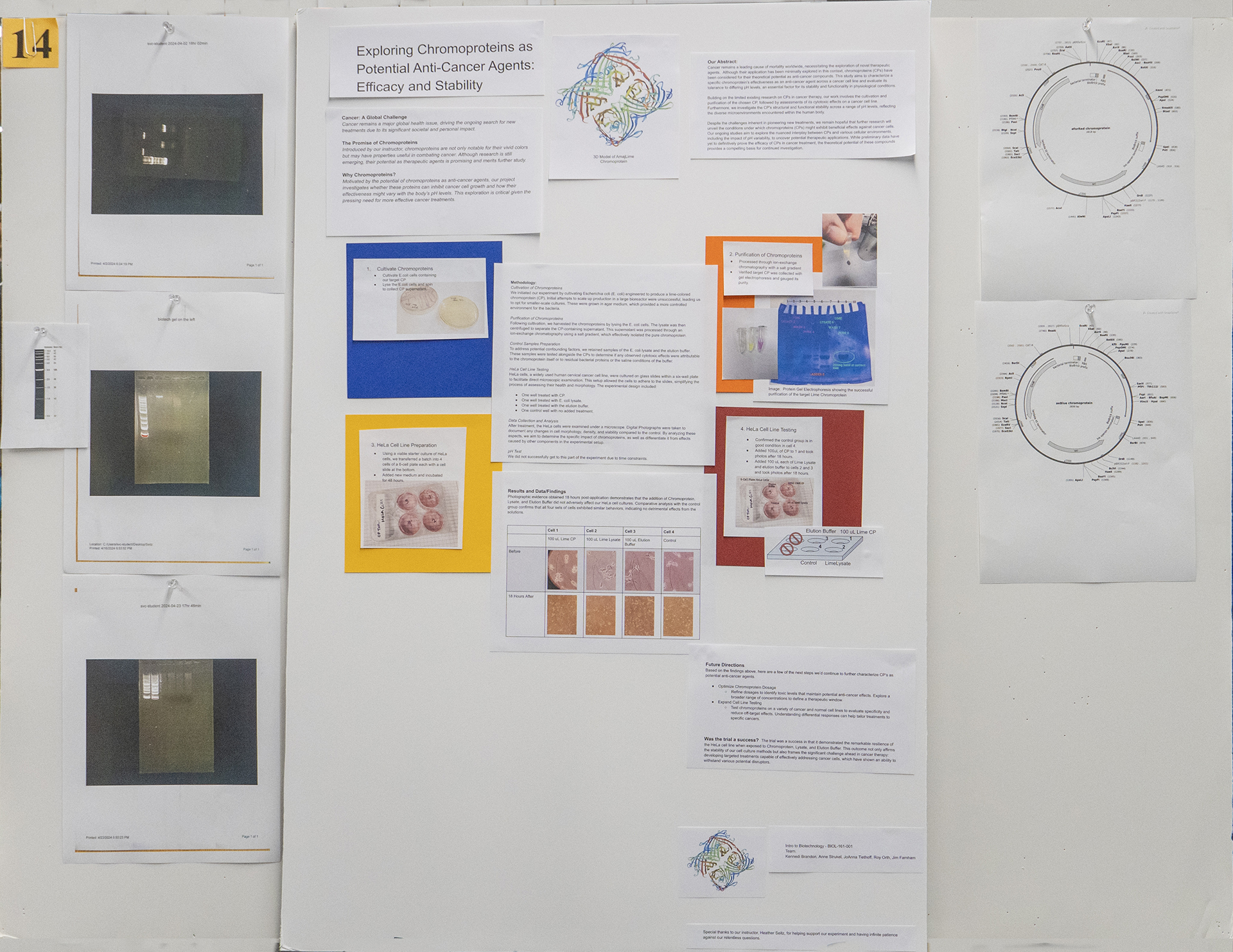
Characterization of Chromoprotein as an Anti-Cancer Agent: Efficacy and pH Tolerance
CoLab, OCB 100
Cancer remains a leading cause of mortality worldwide, necessitating the exploration of novel therapeutic agents. Although their application has been minimally explored in this context, chromoproteins (CPs) have been considered for their theoretical potential as anti-cancer compounds. This study aims to characterize a specific chromoprotein's effectiveness as an anti-cancer agent across a cancer cell line and evaluate its tolerance to differing pH levels, an essential factor for its stability and functionality in physiological conditions. Building on the limited existing research on CPs in cancer therapy, our work involves the cultivation and purification of the chosen CP, followed by assessments of its cytotoxic effects on a cancer cell line. Furthermore, we investigate the CP's structural and functional stability across a range of pH levels, reflecting the diverse microenvironments encountered within the human body. Despite the challenges inherent in pioneering new treatments, we remain hopeful that further research will unveil the conditions under which chromoproteins (CPs) might exhibit beneficial effects against cancer cells. Our ongoing studies aim to explore the nuanced interplay between CPs and various cellular environments, including the impact of pH variability, to uncover potential therapeutic applications. While preliminary data have yet to definitively prove the efficacy of CPs in cancer treatment, the theoretical potential of these compounds provides a compelling basis for continued investigation.
Comments
The faculty mentor for this project was Heather Seitz, Biology.