

Location
CoLab, OCB 100
Start Date
25-4-2024 6:00 PM
Document Type
Poster
Description
Plastic is piling up in the ocean, our backyards, everywhere. While this problem can be helped via recycling, not all plastic can be recycled. PET, the classic #1 plastic, can be recycled, but only to a certain extent; there will always be some waste leftover. The Life Sciences Department at JCCC has launched a study on an enzyme, known as PETase, that can digest PET into into smaller molecules. Though the enzyme works slow, JCCC is researching different changes that can be made to the genetic code of the enzyme, to see how to improve the efficiency of the enzyme. The subject of this particular trial was the change of the 241st amino acid from Asparagine to Threonine. The PETase with this gene mutation was acquired via a site directed mutagenesis reaction, outsourced to a different company. This genetic code was input into E. coli bacteria for further production, and this bacteria was isolated, genetically sequenced, and purified. The resulting enzyme will be tested for functionality and compared with the original PETase, which functions poorly unless at high temperature and high pH, at which point it functions slightly better. Any results are good results, as any research is good research, and simply knowing more about the enzyme will pave the way for the safe degradation of plastic in the future.
Image
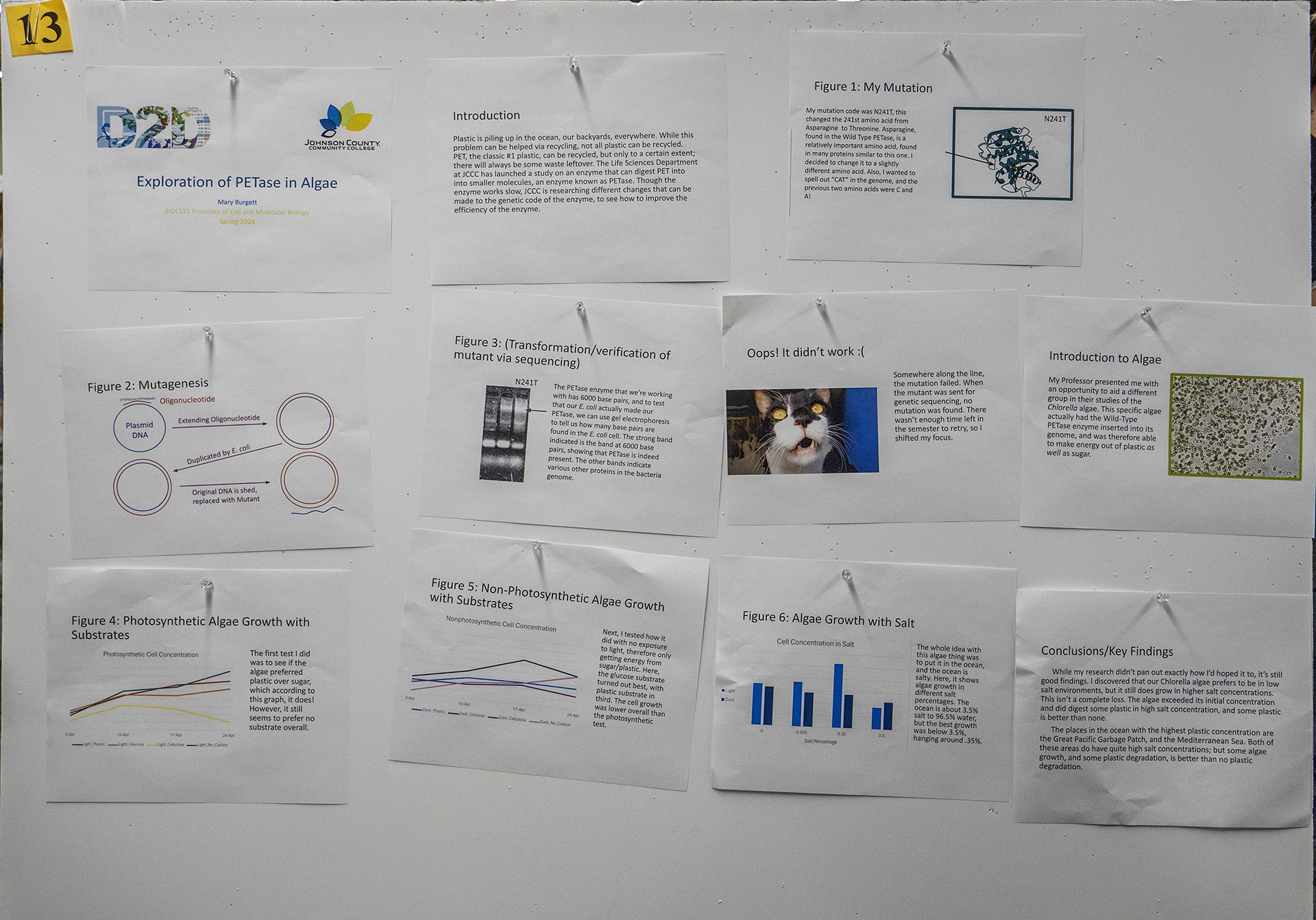
The Mutation of the PETase Enzyme
CoLab, OCB 100
Plastic is piling up in the ocean, our backyards, everywhere. While this problem can be helped via recycling, not all plastic can be recycled. PET, the classic #1 plastic, can be recycled, but only to a certain extent; there will always be some waste leftover. The Life Sciences Department at JCCC has launched a study on an enzyme, known as PETase, that can digest PET into into smaller molecules. Though the enzyme works slow, JCCC is researching different changes that can be made to the genetic code of the enzyme, to see how to improve the efficiency of the enzyme. The subject of this particular trial was the change of the 241st amino acid from Asparagine to Threonine. The PETase with this gene mutation was acquired via a site directed mutagenesis reaction, outsourced to a different company. This genetic code was input into E. coli bacteria for further production, and this bacteria was isolated, genetically sequenced, and purified. The resulting enzyme will be tested for functionality and compared with the original PETase, which functions poorly unless at high temperature and high pH, at which point it functions slightly better. Any results are good results, as any research is good research, and simply knowing more about the enzyme will pave the way for the safe degradation of plastic in the future.
Comments
The faculty mentor for this project was Heather Seitz, Biology.