

Location
CoLab, OCB 100
Start Date
25-4-2024 1:30 PM
Document Type
Poster
Description
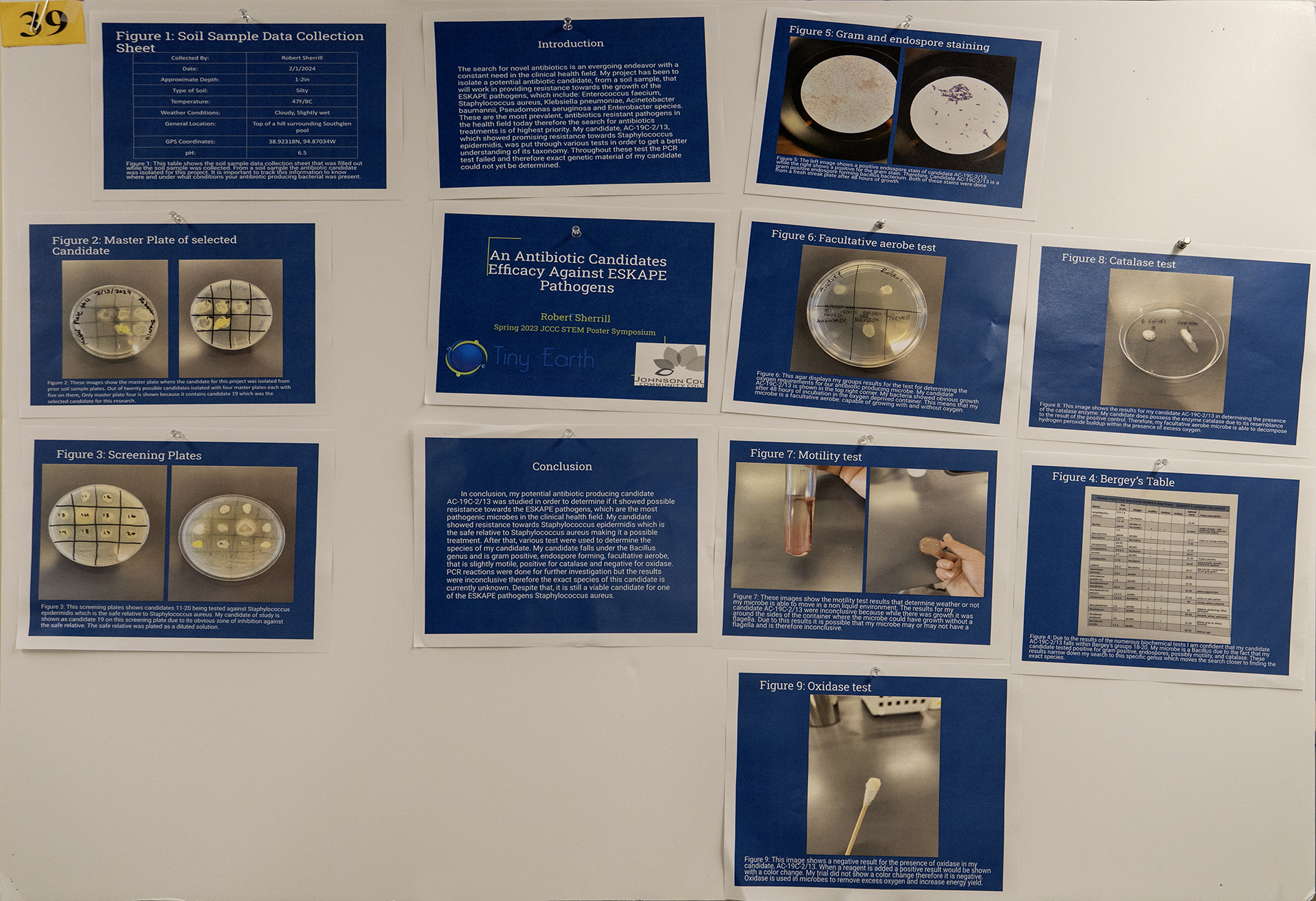
Pathogenic bacteria, or disease causing microorganisms, have always been an enemy towards human survival. It wasn’t till the discovery of penicillin, the first discovered antibiotic, that gave us a fighting chance in defending ourselves against disease causing agents. Antibiotics are either naturally occurring or synthetically produced compounds that destroy or kill microorganisms. Now, the discovery and popularization of these antibiotics has become a driving force in the clinical health field, which serves extraordinary importance for human health. My research is to isolate these antibiotic producing bacteria from soil samples collected locally, and test their antimicrobial abilities against the ESKAPE pathogens. The ESKAPE pathogens (Enterococcus faecium, Staphylococcus aureus, Klebsiella pneumoniae, Acinetobacter baumannii, Pseudomonas aeruginosa, and Enterobacter species), are the main culprits of infections acquired in the health field. Therefore, the importance in treating them is high. From a soil sample collected atop a hill adjacent to a pool in South Glen, Olathe Kansas, I isolated an antibiotic producing bacteria. This antibiotic producing bacteria has shown resistance towards Staphylococcus epidermidis, which is a safe-to-work with relative of Staphylococcus aureus. This therefore shows promise towards being a viable antibiotic candidate against the Staphylococcus aureus pathogen. If this discovery shows full resistance towards Staphylococcus aureus then it could become an important medical tool for treating diseases caused by one of the ESKAPE pathogens, giving a better fighting chance to those in need. With older antibiotics becoming ineffective to mutating pathogens it is highly important to seek new antimicrobial species capable of fully defending people.
Image
Discovery of Viable Antibiotic Candidates Against ESKAPE Pathogens
CoLab, OCB 100
Pathogenic bacteria, or disease causing microorganisms, have always been an enemy towards human survival. It wasn’t till the discovery of penicillin, the first discovered antibiotic, that gave us a fighting chance in defending ourselves against disease causing agents. Antibiotics are either naturally occurring or synthetically produced compounds that destroy or kill microorganisms. Now, the discovery and popularization of these antibiotics has become a driving force in the clinical health field, which serves extraordinary importance for human health. My research is to isolate these antibiotic producing bacteria from soil samples collected locally, and test their antimicrobial abilities against the ESKAPE pathogens. The ESKAPE pathogens (Enterococcus faecium, Staphylococcus aureus, Klebsiella pneumoniae, Acinetobacter baumannii, Pseudomonas aeruginosa, and Enterobacter species), are the main culprits of infections acquired in the health field. Therefore, the importance in treating them is high. From a soil sample collected atop a hill adjacent to a pool in South Glen, Olathe Kansas, I isolated an antibiotic producing bacteria. This antibiotic producing bacteria has shown resistance towards Staphylococcus epidermidis, which is a safe-to-work with relative of Staphylococcus aureus. This therefore shows promise towards being a viable antibiotic candidate against the Staphylococcus aureus pathogen. If this discovery shows full resistance towards Staphylococcus aureus then it could become an important medical tool for treating diseases caused by one of the ESKAPE pathogens, giving a better fighting chance to those in need. With older antibiotics becoming ineffective to mutating pathogens it is highly important to seek new antimicrobial species capable of fully defending people.
Comments
The faculty mentor for this project was Heather Seitz, Biology.