

Location
CoLab, OCB 100
Start Date
25-4-2024 1:30 PM
Document Type
Poster
Description
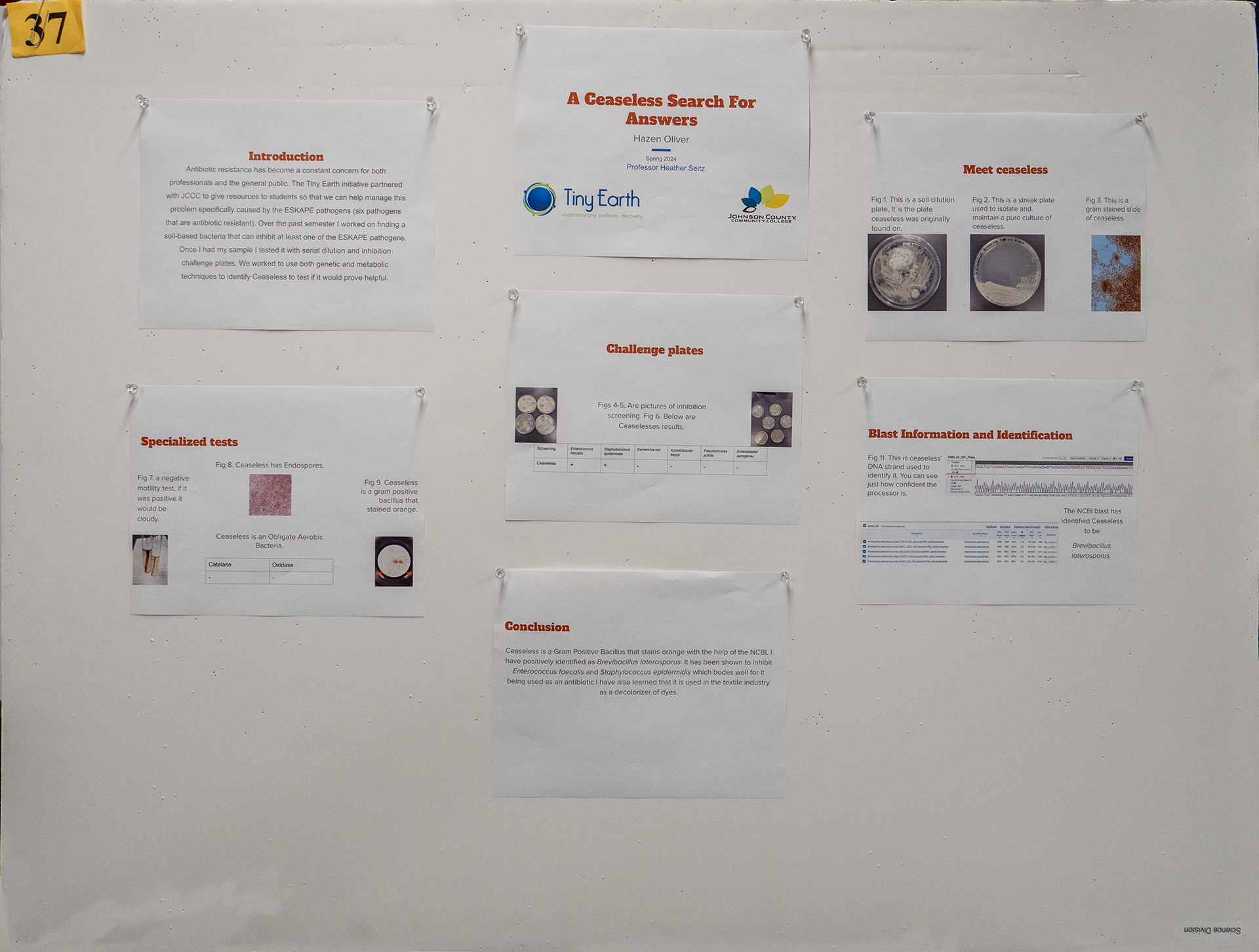
Antibiotic resistance has become a constant concern for both professionals and the general public. The Tiny Earth initiative partnered with JCCC to give resources to students so that we can help manage this problem specifically caused by the ESKAPE pathogens (six pathogens that are antibiotic resistant). Over the past semester I worked on finding a soil-based bacteria that can inhibit at least one of the ESKAPE pathogens. I took a soil sample from my backyard in Overland Park, Kansas, which was a peaty batch of bare soil that in the spring is home to a clover field. Once I had my sample I tested it with serial dilution and inhibition challenge plates. We worked to use both genetic and metabolic techniques to identify Ceaseless so that our work can be furthered. Initially, my candidate, Ceaseless, has been shown to inhibit Enterococcus faecalis and Staphylococcus epidermis, which may be a promising new antibiotic, but the work to solve this concern remains ceaseless.
Image
A Ceaseless Search for Answers
CoLab, OCB 100
Antibiotic resistance has become a constant concern for both professionals and the general public. The Tiny Earth initiative partnered with JCCC to give resources to students so that we can help manage this problem specifically caused by the ESKAPE pathogens (six pathogens that are antibiotic resistant). Over the past semester I worked on finding a soil-based bacteria that can inhibit at least one of the ESKAPE pathogens. I took a soil sample from my backyard in Overland Park, Kansas, which was a peaty batch of bare soil that in the spring is home to a clover field. Once I had my sample I tested it with serial dilution and inhibition challenge plates. We worked to use both genetic and metabolic techniques to identify Ceaseless so that our work can be furthered. Initially, my candidate, Ceaseless, has been shown to inhibit Enterococcus faecalis and Staphylococcus epidermis, which may be a promising new antibiotic, but the work to solve this concern remains ceaseless.
Comments
The faculty mentor for this project was Heather Seitz, Biology.