

Location
CoLab, OCB 100
Start Date
25-4-2024 1:30 PM
Document Type
Poster
Description
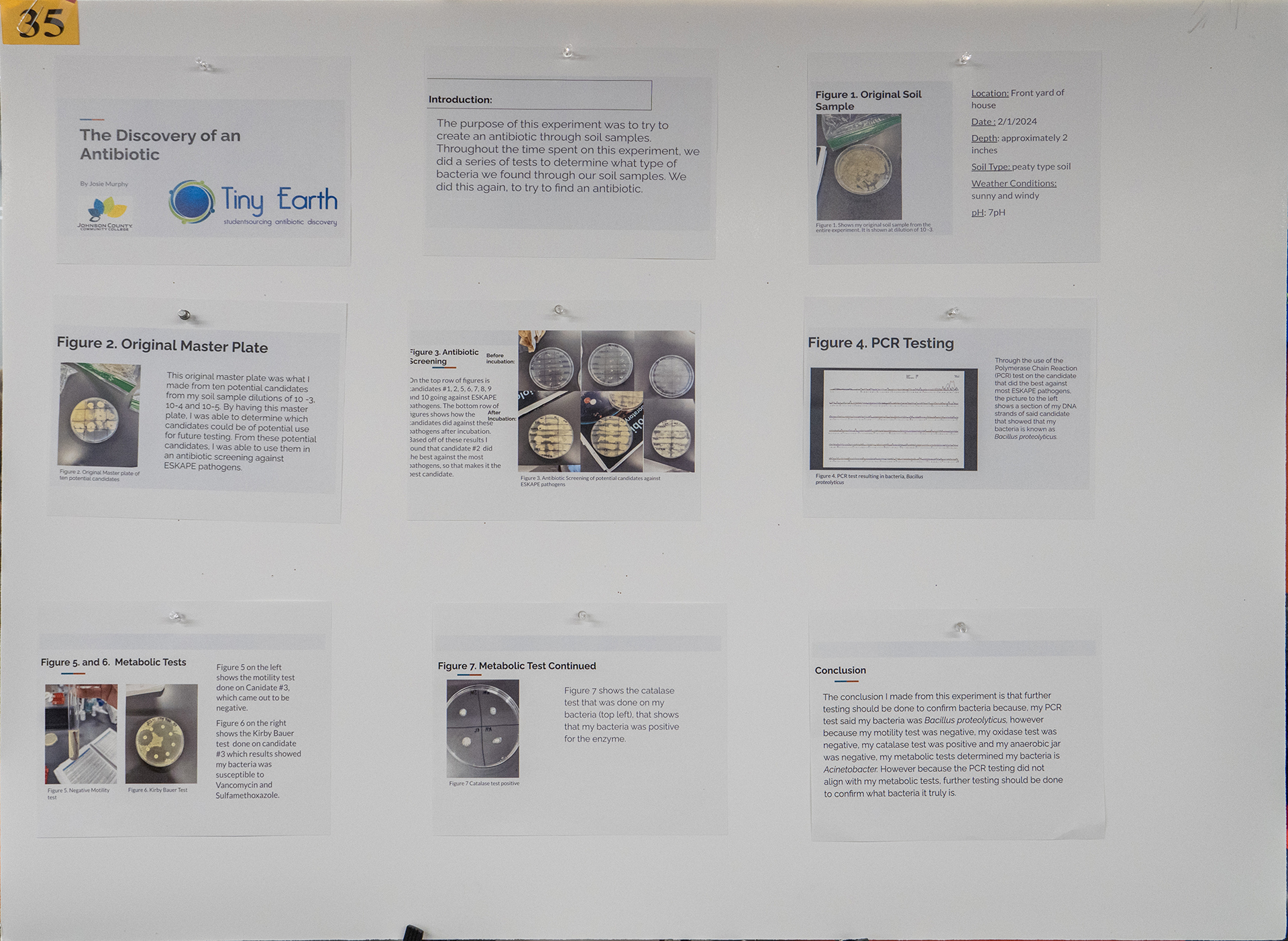
Antibiotic Forming from Soil The purpose of this research was to create an antibiotic from bacteria from soil samples that can be used for further use. The reason being to create these potential antibiotics was because these antibiotics fight infections caused by bacteria, they do this by either preventing their growth or killing them completely. To put this research into action, throughout the semester we collected various samples of soil, and attempted to find potential candidates. The soil sample I collected came from the front of my house, and for our first experiment we made a serial dilution of the sample. After the dilution was taken, we incubated the bacteria to see what growth would occur. After observing the colonies that were grown, we collected potential candidates and grew them onto a master plate. Once again after incubating the master plate, we performed antibiotic screenings against safe-relative pathogens to see if the bacteria grown could go against them. After doing so, we observed and found some that were positive and some that were negative when going up against these pathogens. I had one specific candidate that was positive against two pathogens that was used for further research. That research involved different kinds of staining like, gram staining, spore staining, acid fast staining, and polymerase chain reaction. By performing all of these experiments and research a possible candidate for an antibiotic was found.
Image
Antibiotic Research from Soil
CoLab, OCB 100
Antibiotic Forming from Soil The purpose of this research was to create an antibiotic from bacteria from soil samples that can be used for further use. The reason being to create these potential antibiotics was because these antibiotics fight infections caused by bacteria, they do this by either preventing their growth or killing them completely. To put this research into action, throughout the semester we collected various samples of soil, and attempted to find potential candidates. The soil sample I collected came from the front of my house, and for our first experiment we made a serial dilution of the sample. After the dilution was taken, we incubated the bacteria to see what growth would occur. After observing the colonies that were grown, we collected potential candidates and grew them onto a master plate. Once again after incubating the master plate, we performed antibiotic screenings against safe-relative pathogens to see if the bacteria grown could go against them. After doing so, we observed and found some that were positive and some that were negative when going up against these pathogens. I had one specific candidate that was positive against two pathogens that was used for further research. That research involved different kinds of staining like, gram staining, spore staining, acid fast staining, and polymerase chain reaction. By performing all of these experiments and research a possible candidate for an antibiotic was found.
Comments
The faculty mentor for this project was Heather Seitz, Biology.