

Location
CoLab, OCB 100
Start Date
25-4-2024 1:30 PM
Document Type
Poster
Description
The purpose of this experiment was to find, culture, and test for antibiotic producing microbes found in soil samples. As antibiotic resistance begins to grow more rampant and increasingly more difficult, new sources of valuable antibiotics that differentiate themselves from their predecessors must be discovered. These antibiotics were tested against the “safe relatives” of the six dangerous ESKAPE pathogens, as these ESKAPE pathogens have proven to be a difficult challenge in clinical settings. The soil samples were used to create serial dilutions and serial dilution plates. Ten to twelve promising candidates were selected only from countable plates (roughly 25 – 250 colonies) in order to create a master plate. The master plate was then used to create antibiotic screenings, from which the most promising candidate was isolated onto a quadrant streak plate. The selected candidate was then transferred into a tube to undergo PCR. Afterwards, the final candidate underwent electrophoresis to determine the bacterial species by observing/comparing the amplified 16s rRNA gene.
Image
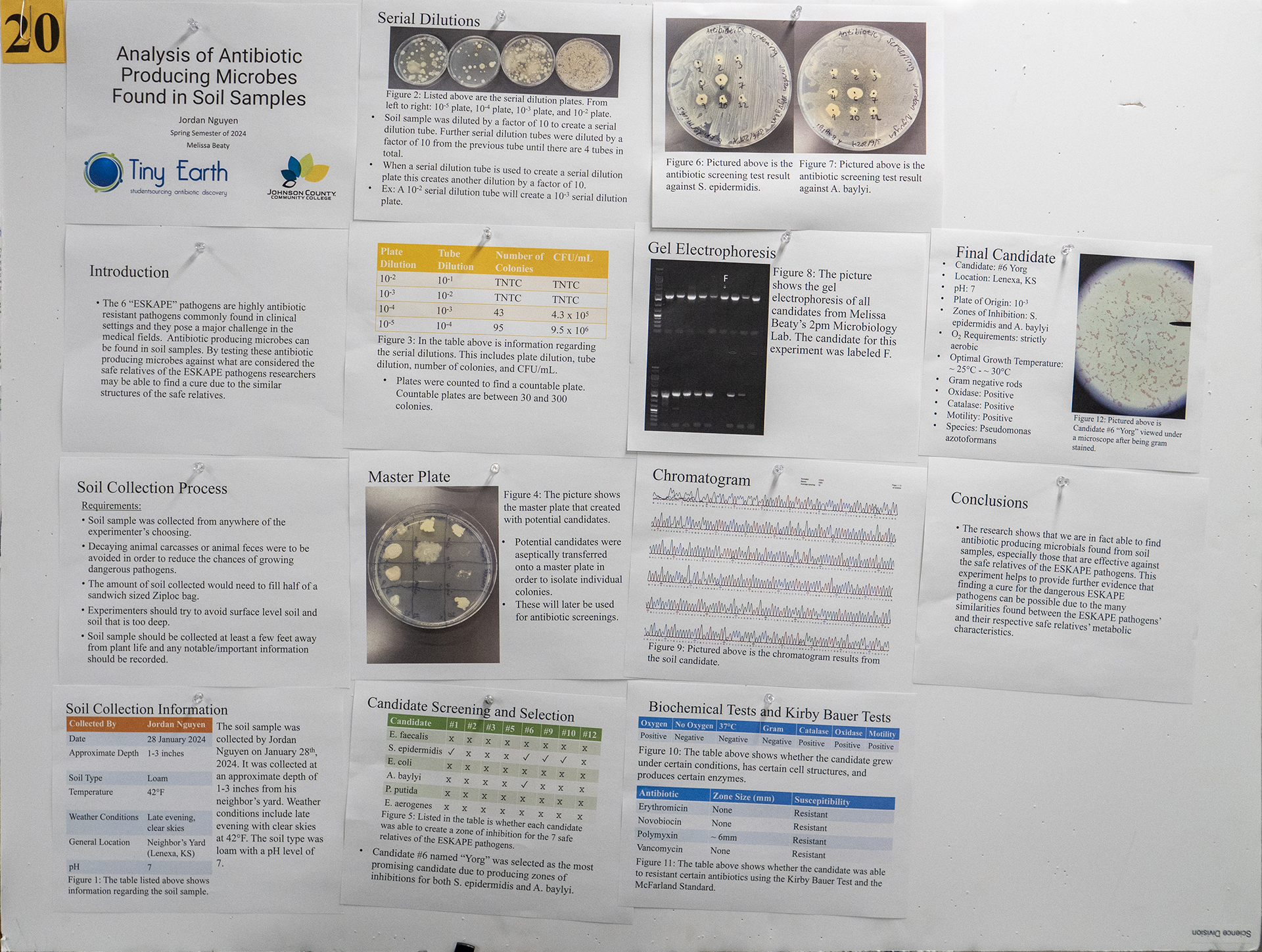
Analysis of Antibiotic Producing Microbes Found in Soil Samples
CoLab, OCB 100
The purpose of this experiment was to find, culture, and test for antibiotic producing microbes found in soil samples. As antibiotic resistance begins to grow more rampant and increasingly more difficult, new sources of valuable antibiotics that differentiate themselves from their predecessors must be discovered. These antibiotics were tested against the “safe relatives” of the six dangerous ESKAPE pathogens, as these ESKAPE pathogens have proven to be a difficult challenge in clinical settings. The soil samples were used to create serial dilutions and serial dilution plates. Ten to twelve promising candidates were selected only from countable plates (roughly 25 – 250 colonies) in order to create a master plate. The master plate was then used to create antibiotic screenings, from which the most promising candidate was isolated onto a quadrant streak plate. The selected candidate was then transferred into a tube to undergo PCR. Afterwards, the final candidate underwent electrophoresis to determine the bacterial species by observing/comparing the amplified 16s rRNA gene.
Comments
The faculty mentor for this project was Melissa Beaty, Biology.