

Location
CoLab, OCB 100
Start Date
25-4-2024 12:00 PM
Document Type
Poster
Description
Antibiotic resistance remains a persistent challenge as bacteria evolve to withstand the effects of antibiotics designed to combat them. The earth's soil, teeming with billions of microorganisms, including bacteria, serves as a vast reservoir. Cultivating bacterial colonies from soil samples allows for the identification of those capable of producing chemicals that inhibit the growth of other bacteria. Colonies exhibiting significant inhibition zones represent promising candidates for antibiotic development. A colony named "Killa," was isolated from a silty soil sample in Gardner, Kansas. Through serial dilution, "Killa" demonstrated potent inhibition against other colonies. Further testing revealed its ability to inhibit Escherichia coli and Staphylococcus epidermidis, suggesting its potential as a robust antibiotic candidate.
Image
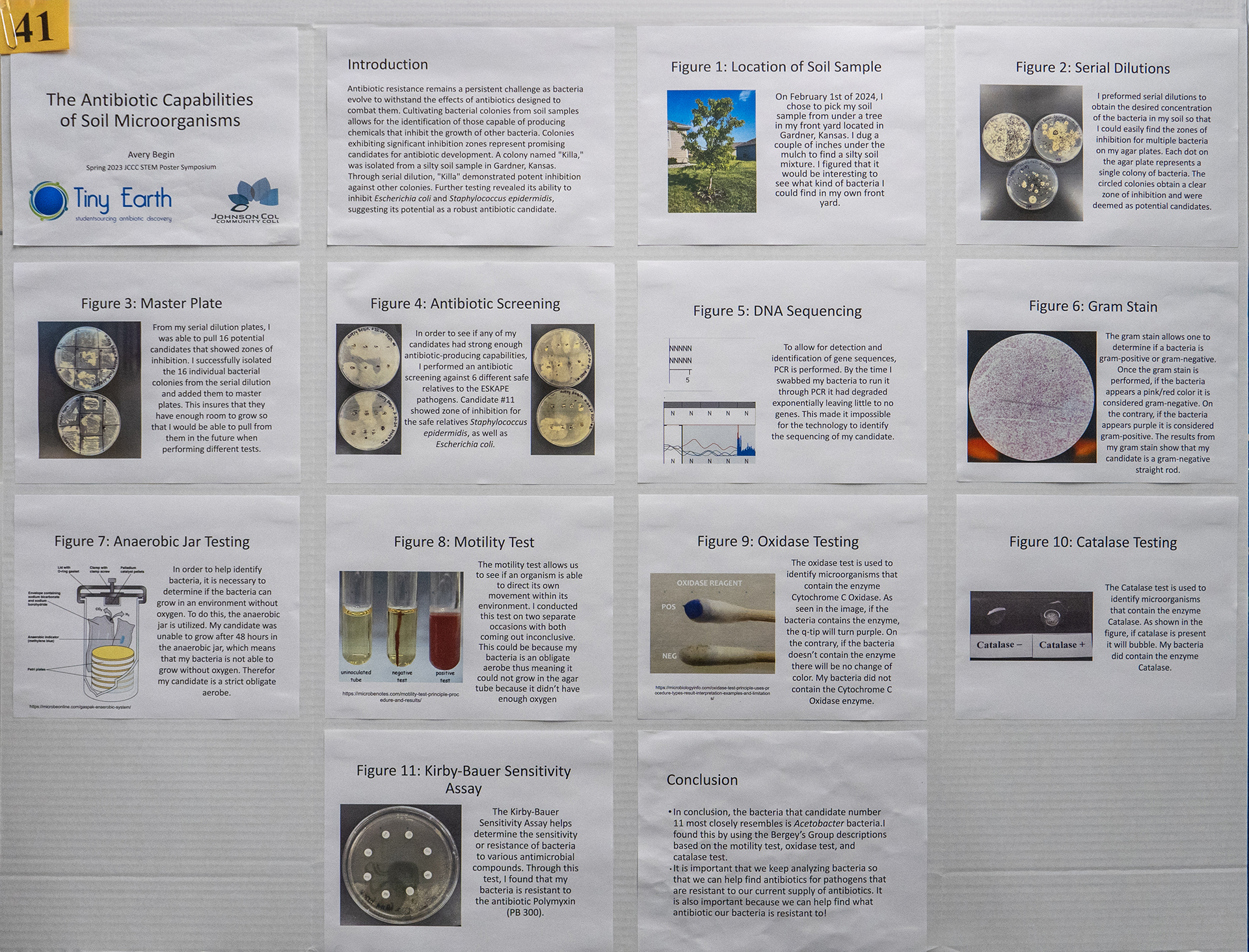
The Antibiotic Capabilities of Soil Microorganisms
CoLab, OCB 100
Antibiotic resistance remains a persistent challenge as bacteria evolve to withstand the effects of antibiotics designed to combat them. The earth's soil, teeming with billions of microorganisms, including bacteria, serves as a vast reservoir. Cultivating bacterial colonies from soil samples allows for the identification of those capable of producing chemicals that inhibit the growth of other bacteria. Colonies exhibiting significant inhibition zones represent promising candidates for antibiotic development. A colony named "Killa," was isolated from a silty soil sample in Gardner, Kansas. Through serial dilution, "Killa" demonstrated potent inhibition against other colonies. Further testing revealed its ability to inhibit Escherichia coli and Staphylococcus epidermidis, suggesting its potential as a robust antibiotic candidate.
Comments
The faculty mentor for this project was Heather Seitz, Biology.