

Location
CoLab, OCB 100
Start Date
25-4-2024 12:00 PM
Document Type
Poster
Description
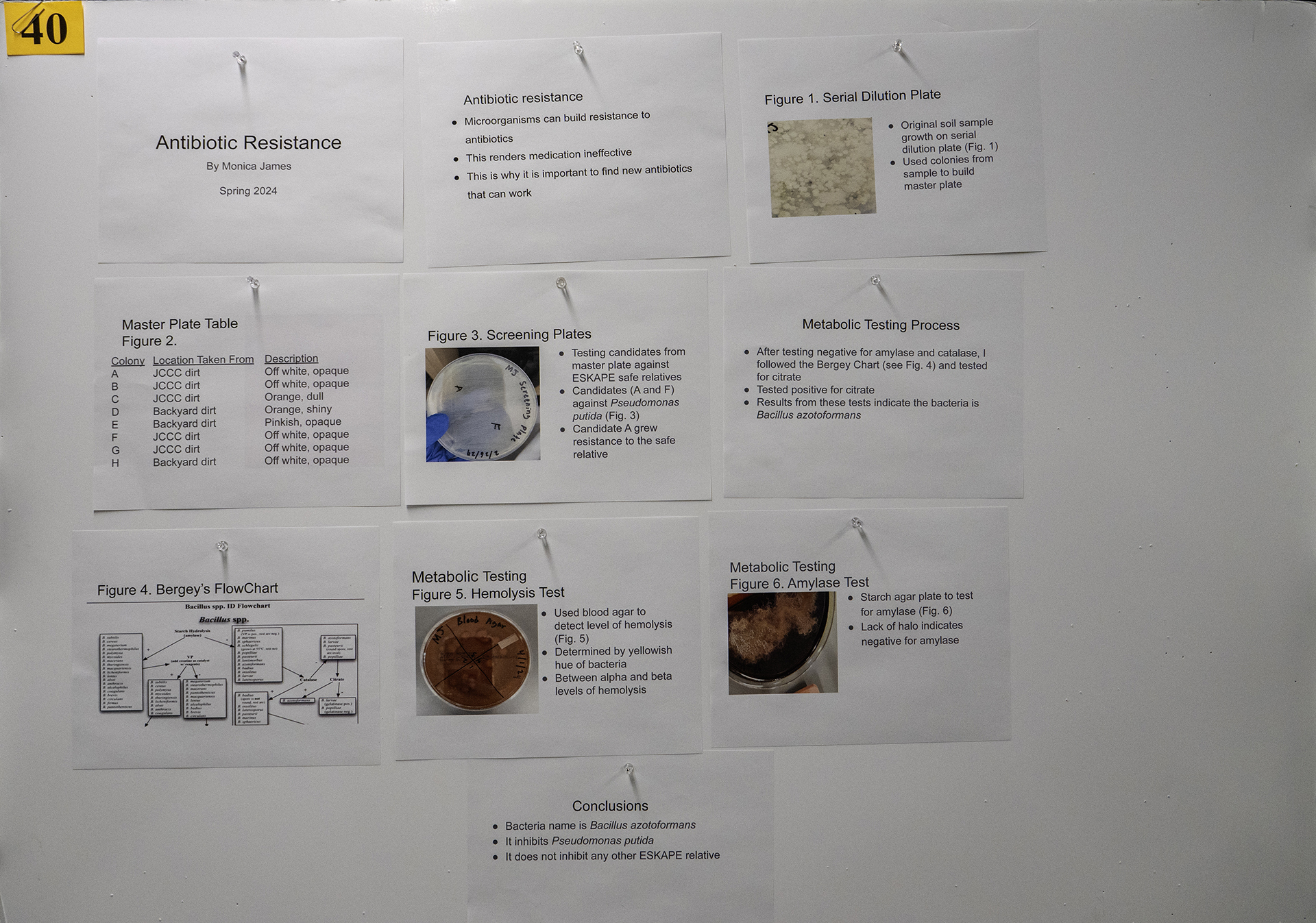
Antibiotic resistance refers to the ability of microorganisms to withstand the effects of antibiotics, rendering the medication against them ineffective. The evolutionary nature of these organisms helps them to evolve in ways that help them to be unharmed by the bacteria in the medication. This is why it is important to find new antibiotics that can work. In our experiment, we used the process of serial dilution to find bacteria that could be potential candidates for antibiotics. Serial dilution is a process through which cultivable microbes can be found. In this experiment, soil samples are used. By diluting the samples at different levels, the difference in growth can then be compared. The purpose is to be able to find good zones of inhibition, which would further be used in the screening process, ultimately to find potential candidates for antibiotics. After collecting soil samples and diluting it in six test tubes, we placed samples of the different dilutions on agar plates. Only one zone of inhibition grew on mine. After that, we used master plates to grow selected colonies on, specifically the ones with zones of inhibition. We have been testing those colonies against safe relatives to see if any are resistant. Only one of my colonies has been resistant to one of the safe relatives. This candidate will be further tested through staining, sequencing, and metabolic tests to identify it.
Image
Serial Dilution
CoLab, OCB 100
Antibiotic resistance refers to the ability of microorganisms to withstand the effects of antibiotics, rendering the medication against them ineffective. The evolutionary nature of these organisms helps them to evolve in ways that help them to be unharmed by the bacteria in the medication. This is why it is important to find new antibiotics that can work. In our experiment, we used the process of serial dilution to find bacteria that could be potential candidates for antibiotics. Serial dilution is a process through which cultivable microbes can be found. In this experiment, soil samples are used. By diluting the samples at different levels, the difference in growth can then be compared. The purpose is to be able to find good zones of inhibition, which would further be used in the screening process, ultimately to find potential candidates for antibiotics. After collecting soil samples and diluting it in six test tubes, we placed samples of the different dilutions on agar plates. Only one zone of inhibition grew on mine. After that, we used master plates to grow selected colonies on, specifically the ones with zones of inhibition. We have been testing those colonies against safe relatives to see if any are resistant. Only one of my colonies has been resistant to one of the safe relatives. This candidate will be further tested through staining, sequencing, and metabolic tests to identify it.
Comments
The faculty mentor for this project was Rachael Ott, Biology.