

Carcinophage: Developing a Protocol for Screening Bacteria for Co-metabolic Biodegradation Potential
Location
CoLab, OCB 100
Start Date
25-4-2024 12:00 PM
Document Type
Poster
Description
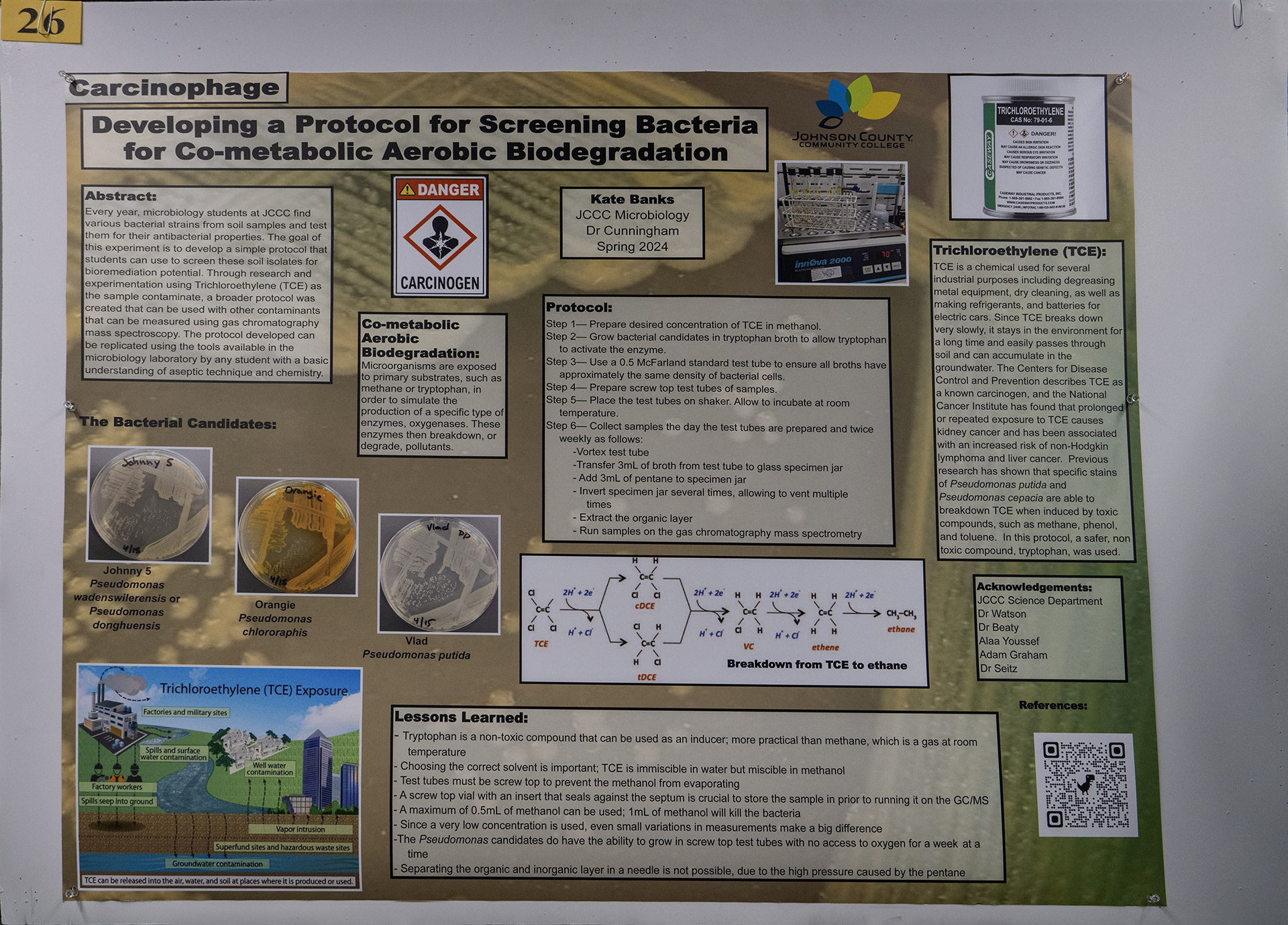
Trichloroethylene (TCE) is a chemical used for several industrial purposes including degreasing metal equipment, dry cleaning, as well as making refrigerants, and batteries for electric cars. Since TCE breaks down very slowly, it stays in the environment for a long time and easily passes through soil and can accumulate in the groundwater. The Centers for Disease Control and Prevention describes TCE as a known carcinogen, and the National Cancer Institute has found that prolonged or repeated exposure to TCE causes kidney cancer and has been associated with an increased risk of non-Hodgkin lymphoma and liver cancer. Previous research has shown that specific stains of Pseudomonas putida and Pseudomonas cepacia are able to breakdown TCE when induced by toxic compounds, such as methane, phenol, and toluene. The goal of this experiment is to develop a simple protocol that future students can use to screen soil isolates for bioremediation potential. Through research and experimentation using TCE as the sample contaminate, a broader protocol was created that can be used with other contaminants that can be measured using gas chromatography mass spectroscopy. The protocol developed can be replicated using the tools available in the microbiology laboratory by any student with a basic understanding of aseptic technique and chemistry.
Image
Carcinophage: Developing a Protocol for Screening Bacteria for Co-metabolic Biodegradation Potential
CoLab, OCB 100
Trichloroethylene (TCE) is a chemical used for several industrial purposes including degreasing metal equipment, dry cleaning, as well as making refrigerants, and batteries for electric cars. Since TCE breaks down very slowly, it stays in the environment for a long time and easily passes through soil and can accumulate in the groundwater. The Centers for Disease Control and Prevention describes TCE as a known carcinogen, and the National Cancer Institute has found that prolonged or repeated exposure to TCE causes kidney cancer and has been associated with an increased risk of non-Hodgkin lymphoma and liver cancer. Previous research has shown that specific stains of Pseudomonas putida and Pseudomonas cepacia are able to breakdown TCE when induced by toxic compounds, such as methane, phenol, and toluene. The goal of this experiment is to develop a simple protocol that future students can use to screen soil isolates for bioremediation potential. Through research and experimentation using TCE as the sample contaminate, a broader protocol was created that can be used with other contaminants that can be measured using gas chromatography mass spectroscopy. The protocol developed can be replicated using the tools available in the microbiology laboratory by any student with a basic understanding of aseptic technique and chemistry.
Comments
The faculty mentor for this project was Jaime Cunningham, Biology.