

Location
CoLab, OCB 100
Start Date
25-4-2024 12:00 PM
Document Type
Poster
Description
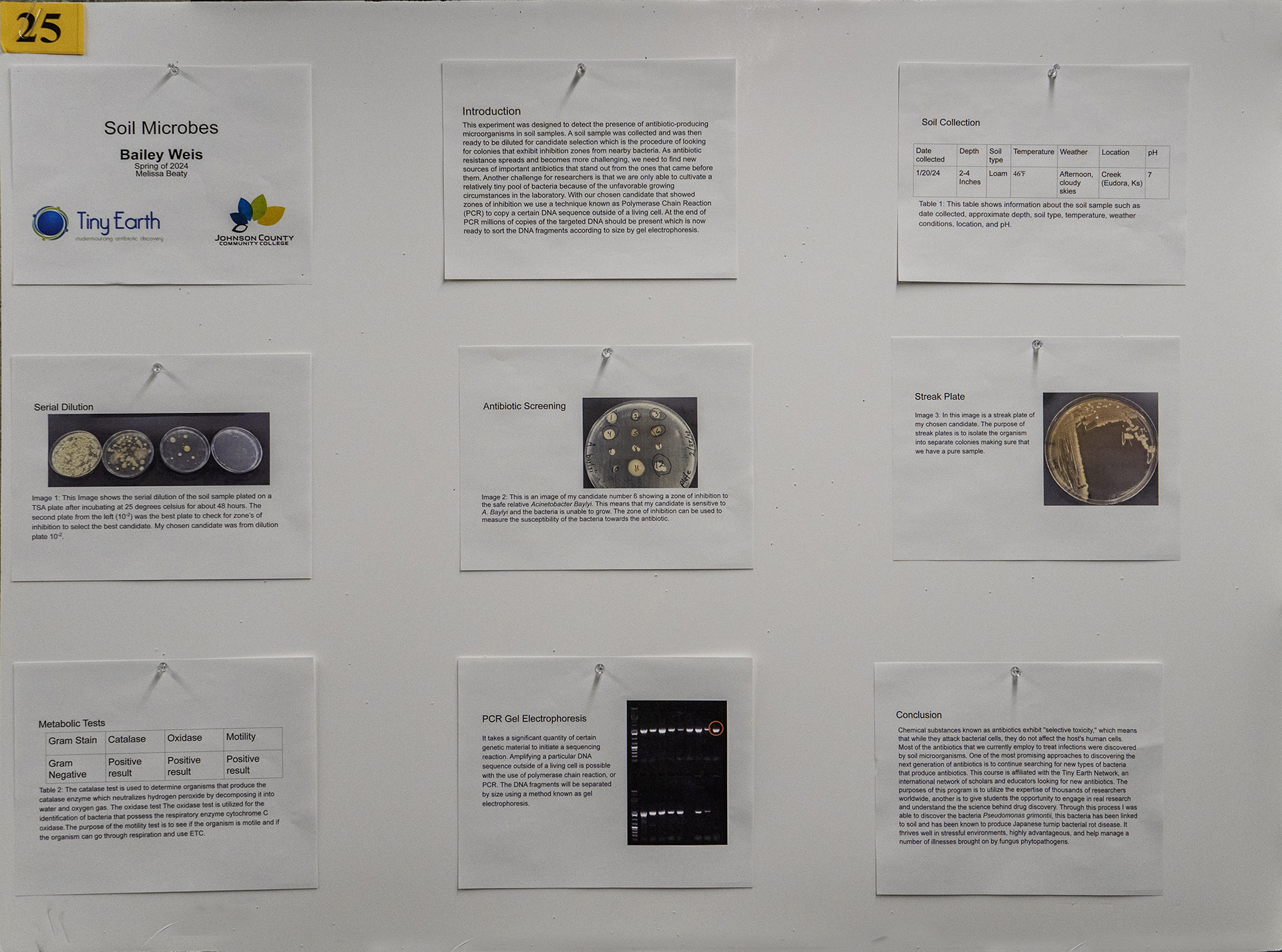
This experiment was designed to detect the presence of antibiotic-producing microorganisms in soil samples. A soil sample was collected and was then ready to be diluted for candidate selection which is the procedure of looking for colonies that exhibit inhibition zones from nearby bacteria. As antibiotic resistance spreads and becomes more challenging, we need to find new sources of important antibiotics that stand out from the ones that came before them. Another challenge for researchers is that we are only able to cultivate a relatively tiny pool of bacteria because of the unfavorable growing circumstances in the laboratory. With our chosen candidate that showed zones of inhibition we use a technique known as Polymerase Chain Reaction (PCR) to copy a certain DNA sequence outside of a living cell. At the end of PCR millions of copies of the targeted DNA should be present which is now ready to sort the DNA fragments according to size by gel electrophoresis.
Image
Soil Microbes
CoLab, OCB 100
This experiment was designed to detect the presence of antibiotic-producing microorganisms in soil samples. A soil sample was collected and was then ready to be diluted for candidate selection which is the procedure of looking for colonies that exhibit inhibition zones from nearby bacteria. As antibiotic resistance spreads and becomes more challenging, we need to find new sources of important antibiotics that stand out from the ones that came before them. Another challenge for researchers is that we are only able to cultivate a relatively tiny pool of bacteria because of the unfavorable growing circumstances in the laboratory. With our chosen candidate that showed zones of inhibition we use a technique known as Polymerase Chain Reaction (PCR) to copy a certain DNA sequence outside of a living cell. At the end of PCR millions of copies of the targeted DNA should be present which is now ready to sort the DNA fragments according to size by gel electrophoresis.
Comments
The faculty mentor for this project was Melissa Beaty, Biology.